Three Pearls
Sunday, September 26, 2010 By Maryam
Three pearls fell down the river, from my broken necklace. I let them go, let them see what I couldn’t, let them encounter adventures I would never dream of.
But don’t look at us, the pearls said while I glanced from the distance, and my feet started to wallk back home over the dusty ground.
Look at the pearls of the Unseen, you are lucky, we are almost there, and we are tears now. Not pearls. You are lucky, they said, for the waiting, the searching, the seeking, is the whole adventure, the great reward, where rivers of pearls become tears of joy. We are now tears going to encounter the ocean of Love. But you are still not there, so feel and cry, and suffer and smile and struggle, because this is where all the signs of Love can lead you to be what we are now. And I sighed and desired to be them.
Thoughts from a young girl.
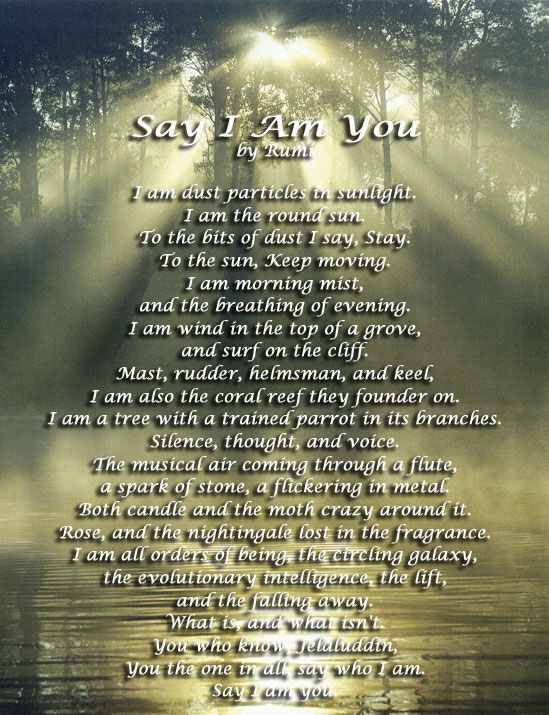
Say I Am With You
Tuesday, March 23, 2010 By Maryam



Beloved
Saturday, January 16, 2010 By Maryam
I dance, I am a woman;
I sing, I have a soul;
I spread flowers over our encounter,
and let them fall
over our hearts...
I give you the cup of wine
in whispers
and in sounds of happiness,
in love poems,
and songs that come from heaven.
I sip from this Love
with tears in my eyes,
babbling the name
of the All-Nothing that sees us, with a smile.
We both are looking for the same;
searching, always searching;
and even if we see...
We still prefer to wonder.
Under the stars I find the Beloved
through my earthly beloved.
You feel paradise
through this love that becomes LOVE.
We are children, we are joy,
we are starting to live the real void
reaching ladders and wings and lights
upon us.
Beloved, you take me to The BELOVED.
Maryam

Sufi Rituals in the Middle East and the Balkans
Wednesday, January 06, 2010 By Maryam
This book offers intimate and moving portraits of Sufism as practiced in five countries. Sufism, the mystical tradition of Islam, is as far from the strident and often violent fundamentalist strain of the religion that has so captured world attention as it is possible to be. Sufis in all parts of the Islamic world are broad-minded, tolerant, and non-violent, their quest only to find and approach God through all means, including poetry, music, and dance. Historian Nicolaas Biegman has been observing and photographing Sufi practice and ritual in different Muslim lands for many years, and here in this collection of extraordinary photographs he feels the pulse of the Sufi experience, with its enormous variety in discipline and exuberance, intellectualism and spontaneity, in Egypt, Syria, Bosnia and Herzegovina, Kosovo, and Macedonia. In accompanying texts he explores what lies behind the rituals, and explains aspects of Sufi life and practice such as the position of women.
Author Biography:
NICOLAAS (NIEK) BIEGMAN holds a Ph.D. in Balkan history, and is an expert on Islam. He has produced a number of photographic books on Egypt, Haiti, Manhattan, and most recently a Sufi community in Skopje (God's Lovers)
PAL plans conference on Sufism
Saturday, January 02, 2010 By Maryam
ISLAMABAD (APP) - Pakistan Academy of Letters (PAL) has planned to arrange three-day International Conference on Sufism from March 14. The official sources of the academy told this agency that 80 delegates from around 40 countries are expected to participate in the conference.
The notable personalities having diverse knowledge about sufism and mysticism will share their views on the occasion.
The international conference would provide a platform to more than 200 delegates within the country to participate in the conference.
Sources said that PAL would translate books of Sufi poets belonging all the four provinces in eight different languages.
The translated books would be given to all the participants as it will help to project true image of the country on international level.
The sources informed that a international conference was also arranged in 1995. The writings of Pakistani writers from all Pakistani languages were translated in UNESCO languages and sent to different countries.
These books are still the identity of Pakistani literature in libraries there. However, PAL has also decided to set up a National Translation Bureau in the academy through translating Pakistani literature in foreign languages and the foreign literature into Pakistani languages, the sources added.
Beshara and Ibn 'Arabi : A Movement of Sufi Spirituality in the Modern World
Friday, December 25, 2009 By Maryam

Sufism Books among other subjects - 18th century library reopens
Friday, December 25, 2009 By Maryam
Don’t give me back…
Thursday, December 10, 2009 By Maryam
“Don’t give me back to my old companions.
No friend but you. Inside you
I rest from wanting. Don’t let me
be that selfishness again."
Unseen Rain. Quatrains of Rumi. By John Moyne and Coleman Barks
Threshold Books
Image credit: Iskandar
Sufis and Jesus
Thursday, December 10, 2009 By Maryam
Christianity is rooted in the belief that Jesus is the Son of God, so is Islam’s version of Christ a source of tension, or a way of building bridges between the world’s two largest faiths?
The Sufi philosopher al-Ghazali described Jesus as "the prophet of the soul" and the Sufi master Ibn Arabi called him "the seal of saints".An article by Mehdi Hasan about a new book by the former Cambridge professor of Arabic and Islamic studies Tarif Khalidi on Newstatesman.com
Three Books on Sufism
Tuesday, December 08, 2009 By Maryam
The titles are:
Ikmalush Shiyam
Description : Ikmalush Shiyam (Perfection of Morals) is a treatise for the Muhibbeen (Lovers of Allah). Although every Mu’min is a Lover of Allah, this treatise is largely directed to the attention of the Muhibbeen who are conscious of Divine Love. Nevertheless, it will benefit even the unconscious lovers by inducing in them some consciousness of the love lying dormant in their hearts which have been created for being the Abodes of Divine Love. Since Ikmalush Shiyam is a treatise for Muhibbeen, it speaks the language of love – Divine Love. Thus, the book abounds with paradoxes and seemingly contradictory calls and cries sounded for the guidance of those who understand the language of Allah’s Love. The advices and prescriptions herein are balm for the Souls searching the Path of Love, leading to their Beloved, Allah Azza Wa Jal. This book is not for the rational probing of a sceptic mind stunted by crass materialism.
Author : Maulana Muhammad Abdullah Gangohi
Scattered Pearls
Description : This is a short compilation of selected sayings and anecdotes of the illustrious Auliyaa (the special friends—saints) of Allah Ta'ala. The perpetuation of Islam in its original purity has been ensured by the various classes of Auliyaa among whom are also found the great Fuqaha, Muhadditheen and Mufassireen. The sayings and anecdotes presented in this book belong to the domain of Islamic morality, spirituality and the remembrance of Allah, which in fact is the goal of life. No order has been observed in this compilation. It is essentially a book of Naseehat—advice and admonition.
Author : Mujlisul-Ulama of South Africa
Shariat and Tasawwuf
Description : A SINCERE Wali of Allah is the Representative (Khalifah) of Allah Ta’ala on earth. He is the rooh (soul) of creation. All creation exists on his presence. Everything supplicates for the grace emanating from his spiritual effulgence. His heart and brain are the repositories of Divine Knowledge and Grace. Allah Ta’ala has decreed him (the Wall) as His special servant and has grated him the closest of proximity. Allah Ta’ala has expanded his breast for the understanding of the meaning of His Kalaam (The Qur’aan Shareef). Allah Ta’ala has granted him the Knowledge of the Qur’aan and has revealed to him the inner meanings and realities of the verses so that he may guide mankind and cure its spiritual maladies. He (the Wall) has been appointed by Allah Ta’ala to execute the obligation of Amr Bil Ma’roof (Commanding virtue) and Nahu anil Munkar (prohibiting evil)
Author : Hadhrat Maulana Maseehullah Khan
TheMajlis.net
sufism
tasawwuf
sufi poems
sufi masters
Sufism. An Article
Tuesday, December 08, 2009 By Maryam

The author has named it "Sufism, the other face of Islam". Unfortunately, when we speak of Islam, many are reminded of Bin Laden, Al Qaeda, terrorism, bigotry, oppression of women. But not all of Islam is the case (not all Basques are ETA). There is a large moderate Islam, and within it, a current extremely old one, called Sufism, practiced by millions of people around the planet.
To not enter into Islamophobia (hatred of Islam), I would like you to read some words of a current Algerian Sufi master, Khaled Bentuonés, and think whether we should continue to say that Islam is carried to fanaticism.
It would be the perfect counterpoint to be showed as a reading in class.
Unfortunately today, Islam has become an ideology, a narrow religion, a limited thing (...) an instrument of mass manipulation.
The generous one gives himself a great good and creates an atmosphere of happiness around which increases their own joy of living.
Contrary to what many think, the great holy war (jihad) is not intended to spread Islam under the rule of a tyrant (...) The Prophet himself said: This is the great war that everyone should take against their own selfishness "(...) This is a war to fight the economic crisis, poverty, against new diseases ...
Doing my duty and my responsibility to assume within society, I give to my work a noble character (...) If we all did our work as if were prayer (in the form of prayer), we would perform this duty out as best as possible and we would not cheat not hustling, and it would be for us the best way forward in life.
Bentuonés Khaled Shaikh Sufism, the heart of Islam. Ediciones Obelisco, 2001
This is just the opposite of what we talked about some time discussing the movie Agora. Religion for the understanding not to hate. Something like what the great mystic of Al Andalus, Ibn Arabi, wrote in the thirteenth century
My heart has become capable of every form: it is a pasture for gazelles and a convent for Christian monks,
And a temple for idols, and the pilgrim's Ka'ba, and the tables of the Tora and the book of the Koran.
I follow the religion of Love, whichever way his camels take. My religion and my faith is the true religion.
Article written by:
Vicente Camarasa -
Image credit: asbf48 (ANTONIO)
sufism
tasawwuf
sufi poems
sufi masters
Turkey to honor Persian poet Mowlavi
Sunday, December 06, 2009 By Maryam

Turkey is planning to hold a ceremony in commemoration of the world-renowned Persian poet Mowlavi in his eternal resting place in Konya.
The 10-day event will include mystic musical performances and various symposiums about the Sufi poet.
Visitors will also have the chance to watch Whirling Dervishes dancing the Sama, the traditional trancelike meditation of Sufism.
The Mowlavi symposium will host prominent Mowlavi experts from around the world including Dr. Mohammad-Ali Movahhedi from Iran.
Jalal ad-Din Mohammad Balkhi known as Mowlavi was a 13th century Persian poet, mystic and theologian, better-known for his six-volume poem Masnavi considered to be one of the greatest works of both Islamic mysticism and Persian literature.
UNESCO named the year 2007 as the year of Mowlavi in honor of the Persian poet's outstanding achievements.
Source: PressTv
sufism
tasawwuf
sufi poems
sufi masters
Sufism Books
Sunday, December 06, 2009 By Maryam
TITLES:
Sufis of Sindh
Dr. Motilal Jotwani (1986)
Early Turkish Mystics in Turkish Literature (2006)
Memed Faud Koprula
Discourses of Rumi (It is What It is - Fihi Ma Fihi) (1999-2000)
A. J. Arberry
The Persian Mystics: Jalalud Din Rumi (1912)
F. Hadland Davis
The Sufism of Rubaiyat (1908)
Norton F. W. Mazeldin
Life of Omar Al-Khayyami(1905)
J. K. M. Shirazi
Rubaiyat of Omar Khayyam (1900)
Edward FitzGerald
Sufism Omar Khayyam and E. Fitzgerlad (1915)
A. Bjerregaard
Thanks to Academy of Punjab in North America
sufism
tasawwuf
sufi poems
sufi masters
Ode Ibn Arabi
Friday, December 04, 2009 By Maryam
 O Marvel! a garden amidst the flames.
My heart has become capable of every form:
it is a pasture for gazelles and a convent for Christian monks,
and a temple for idols and the pilgrim's Kaa'ba,
and the tables of the Torah and the book of the Quran.
I follow the religion of Love: whatever way Love's camels take,
that is my religion and my faith.
|


sufism
tasawwuf
sufi poems
The Tree of Being
Friday, December 04, 2009 By Maryam

THE TREE OF BEING by Ibn 'Arabi interpreted by Tosun Bayra.
The Tree of Being (Shajarat al-Kawn) is a treatise written by Ibn Arabi (1165-1240), one of the greatest figures in both Islamic and universal mysticism. He wrote close to five hundred books and manuscripts. Many of them are short, but some, like Fusus al Hikam and Futuhat al Makkiyah, are books of many volumes. Ibn Arabi knew and influenced the great men of his time, Ibn Rushd (Averroes), Jalaluddin Rumi, Suhrawardi, and others.
His influence spread beyond the Islamic world and entered medieval Europe. Asin Palacios and Salverda di Grave have pointed out that Dante in the Divina Comedia derived from Ibn Arabi the great design of Hell and Paradise and also the image of the beautified young woman as guide to the Divine.
The Tree of Being is an inspired description of the cosmos and the perfect man as microcosm, expressed in beautiful metaphysical and poetic imagery. Ibn Arabi's devotion to the Prophet Muhammad as the perfect man provides instruction in Islam for the ones who are interested in learning the essence of this religion.
The book has five sections. First is the translator's introduction including a biography of Ibn Arabi and a discussion of his approach
to Sufism. Second is an interpretation of Ibn Arabi's Tree of Being, a commentary on the mystical elements of the Qur'an and Islam. Third is Ibn 'Arabi's description of the character and actions of the Prophet Muhammad. The fourth section is his listing of the two hundred names and attributes of the Prophet.
The Tree of Being Book
sufism
tasawwuf
sufi poems
sufi masters
New Uploaded E-Book
Saturday, November 28, 2009 By Maryam

I have uploaded a new e-book:
Mysticism and magic in Turkey; an account of the religious doctrines, monastic organisation, and ecstatic powers of the dervish orders (1912), by Lucy Mary Jane Garnett.
You can download it at the "Pearls of Wisdom" Section, which is on bottom section as I have changed this blog design.
Thank you
sufism
tasawwuf
sufi poems
sufi masters
dervishes
Islam
Turkeys
Lawa'ih, a Treatise on Sufism
Saturday, November 28, 2009 By Maryam
Hackenberg Booksellers especialises in scholarly, out of print, rare and unusual books.
Place Published: London
Publisher: Royal Asiatic Society
Date Published: 1928
Description: Facsimile of an old ms. With a translation by E. H. Whinfield & Mirza Muhammad Kazvini, and preface on the influence of Greek philosophy upon sufism. Reprinted with additions and corrections. xvii, 61p., plus the 56-page facsimile of the 10th-century Persian manuscript. Original blue cloth. (Oriental Translation Fund. New series, 16).
Price: $85.00
sufism
tasawwuf
sufi poems
sufi masters
Evidence
Tuesday, November 24, 2009 By Maryam

Caressing me in a whisper,
sounds that I could never hear
or feel.
Nights of thousands stars, brilliant as the Jewel I see from space,
all of them reunited,
in the glimpse of a second,
an image I could never forget….
The calmness came to life,
after the shadows dancing,
YOU embraced my destiny.
Over mountains of silver and sand,
of gold and fresh honey,
I hear the whisper again.
And you Are, the above and beyond,
the last ladder of myriads of ladders,
this child who became a man child
without sorrow, again happy,
again filled with the Truth
and without solitude anymore.
And YOU, whom I thank endlessly
for you took this child and drove him to the Love
Forever
In Eternity.
Maryam
Teachings of Sufism
Sunday, October 25, 2009 By Maryam

Daughter of Fire
Saturday, October 10, 2009 By Maryam

Found at Amazon.co.uk