Wise Words
Friday, April 20, 2012 By Maryam
Jashn e Khusrau
sufism
tasawwuf
sufi poems
sufi masters
Art in Sufism
Friday, April 20, 2012 By Maryam

This is a breathtaking water color painting made by S. a. Noori. An article about a recent exhibition in Islamabad covers the spirituality that lives in them:
From Tribune.com./pk:
Noory’s work is nuanced with Sufism- white bearded men in trance, holding the Quran. Perhaps the most intriguing piece is a painting of a tall, bearded man with his hand outstretched upwards holding onto a rope as he looks serenely towards the sand. The rope goes straight into the sky and out of the painting where the viewer is left wondering where the other end of the rope must be.You can read the complete article here.
sufism
tasawwuf
sufi poems
sufi masters
Sanam Marvi
Friday, April 20, 2012 By Maryam

From GulfNews comes this article about Sanam Marvi, considered one of the youngest singer-story tellers:
The rising voice of Sufi music
It's about love … the love of humanity.
It's about a world with no boundaries, no violence and no hunger.
It's about a path that says the only true thing to live by is ‘Haq' or ‘right'.
Its instrument is music. Its storytellers are poets and singers.
Its battle, or ‘jihad', is against the ever-manifest human ego.
Sufism is — compassion. And Sanam Marvi perhaps its youngest storyteller.
To continue reading this article please click here
sufism
tasawwuf
sufi poems
sufi masters
What is Real Love?
Friday, April 20, 2012 By Maryam
tasawwuf
sufi poems
sufi masters
New Sufism E Books Uploaded
Wednesday, April 18, 2012 By Maryam
A list of new uploaded books to the section “Pearls of Wisdom”
Ibn Arabi Beginning of Human Bodies
The Takfeer Of Ibn Arabi
THE MUHAMMADAN INHERITANCE
Hadhrat Khalifatul Masih I on Ibn 'Arabi
Ibn Arabi Sufi Physics
A Brief Life Sketch of Shaykh Ibn Arabi al-Shaykh al-Akbar
Ibn `Arabi
Ibn 'Arabi and His Interpreters
Ibn Arabi: philosophy and reason
Ibn 'Arabi's own Summary of the Fusus
To download these e books, just check the section Pearls of Wisdom on right pane.
Thanks to http://findpdfbooks.com
Finding the Mystic Life in All of Us
Wednesday, April 18, 2012 By Maryam
To read the full article, visit this article that appeared on the Huffington Post.Mysticism seems to move beyond the barriers of duality created by traditional religious doctrines, and expresses the "one Reality" that the saint-like Hindu, Mātā Amritānandamayī Devi, known as Ammachi, addressed during her 2000 visit to the United Nations. Mysticism is the search for an accord with, or awareness of, a spiritual truth or God through direct experience or insight. This idea is investigated by one of Ammachi's followers, Ethan Walker III, who, in the Mystic Christ, claims to have found God in his own life. He declares:
By exploring other faiths we begin to see what is common to all paths: love, tolerance, innocence, compassion, devotion to God, forgiveness and service to others. As these essential aspects are clarified and reinforced by their appearance again and again in the major faiths of the world, we begin to find acceptance and tolerance toward other faiths.
Stanford's Özgen Felek investigates the power of dreams in Sufism
Wednesday, April 18, 2012 By Maryam
Through a study of dreams, Özgen Felek charts the ascendance of the 16th-century Ottoman ruler Sultan Murad III from humble disciple to spiritual and political leader.
BY KELSEY GEISER
The Humanities at Stanford
Every night when the 16th-century Ottoman ruler Sultan Murad III went to bed, he looked forward not just to rest, but also to the guidance he would find in his dreams. In the morning, Murad, the grandson of Suleiman the Magnificent, reported his dreams to his Sufi – a mystical Islamic master who interpreted and transcribed the signs and symbols to help the sultan make decisions about his empire and his personal progress.
One night while dreaming of a boy with "a bejeweled crown on his head," the sultan reported hearing a voice in his dream that said, "It is not a boy, it is the religion of Muhammad and the religion of Islam; it is the religion of Muhammad."
Hundreds of dream narrations like this were eventually compiled into a bound manuscript that established the ruler not only as a religious leader but also as an important authority figure.


Sufism and Peace
Wednesday, April 18, 2012 By Maryam
This article talks about how scholars and educationists in India are urging the government to hold an international conference on Sufism to promote the message of peace and love as well as an invitation to people from all over the world to attend the conference in which it would be asked the creation of a Sufi University for research.
Call to hold international moot on Sufism
COMPASSION
Wednesday, November 09, 2011 By Maryam
Then, I saw the man, the bearded man. How long had he been lying on the floor? How long had he stayed in the desert? He mumbled and then his voice became clear. He said that he had spent 40 days in the desert, trying to find a spot that others tried to veil for him. He had left his camel, and he didn't know if he would find him again. He spent whole nights under the stars with just water and dates in his pocket. He mumbled again. The youngsters asked him many questions, among them "did you see your daughter? God's willing you will pay for that in the Judgement Day". Well, I thought the man looked drunk, but that was not possible, he didn't smell alcohol at all, and he was a man of religion. A happy unconscious sad face, a man who didn't understand the meaning of his fatality. Who had spent days trying to find something without success. I could only ask "What were you looking for"? He became almost angry and replied : "I've been looking for you, and you, and you too, and you, and you...." pointing to all of us, with a trembling, infirm finger, with a long nail and fiery eyes. We are not people from the desert, and we are not better than you, I said. "Probably not", he replied, but what I was looking for was here, the mere life, the mere breath, the simple joy, the dirty laugh, the deep compassion." As I tried to get rid of his hand who grabbed me by my skirt, he looked to the sky and said: "I do not own anything, yet I receive so much mockery, so much help, so much attention". The youngsters looked at him startled. And he became a dazing voice, saying poems aloud, thanking God for the dust, for the so called empty days and nights in the desert if that was to find our love and also disrespect, for "all that comes from humanity becomes a necessary lesson in my life". He stood up, and left with help of a cane, his cloths dirty and his feet naked. We all spent a few talking about what had just happened, when the youngest boy pointed to the pavement where that man had been lying and said "Look!, a book he left!" I took the book, a little book, very old and used, and read the first sentence: "You helped me find my way, now I can die in peace. I could not speak, I had no time to, they all took my words before I was even going to utter them". You will never see me again in this life. I am free. And suddenly, the minaret let waves of candor come to our ears and hearts. The muezzin was calling us for a prayer.
The mysterious man never came again, and finally, the youngsters avoided that they had just invented the story of him beating his daughter. For they had never seen that man before. The following weeks I would stare at the same point but the man wasn't there. The youngsters would look at me with a question mark on their faces. "No, I haven't seen him". And after all, God always sends mysteries that can never be solved until we are wise enough to perceive the source of such mysteries. These youngsters now, when they see me, they greet me and look more serious than before. Somehow they have grown up a little more and they approach to give me some words of respect. About the woman, she screams my name until I turn and see her, and invites me to go to her house and try her dinner with her family. We have become good neighbors all of us, and still the minaret smiles to the crowd and to us, while the birds sing strange songs they only understand.
sufism
tasawwuf
sufi poems
sufi masters
I wish...
Wednesday, November 09, 2011 By Maryam

sufism
tasawwuf
sufi poems
sufi masters
Lubna
Monday, January 31, 2011 By Maryam

The Library of al-Hakam (al-Andalus) was the most important one, during caliph al-Hakam II (961-976), founded by the Omeya Dinasty. He also created the sina’at al-nas where copists would work in excellent calligraphy, like Abu Fadl b. Harun, of Sicilian origin, and Sa’aid b. Muqqadas as well as the Lubna women (al-Hakkam secretary) and Fatima
Fractal Heart
Sunday, January 30, 2011 By Maryam

sufism
tasawwuf
sufi poems
sufi masters
sufi teachers tasawwuf
The Breath of the Merciful
Sunday, January 30, 2011 By Maryam
The Breath of the Merciful is understood as the cosmic dynamic that vitalizes the many in the One. It is the ever-present ‘Breathing’ that makes it possible for this infinite universe of duality to come into being while never being other than the nondual essence of the One. Seeing the nature of this dynamic gives us a chance to intuitively understand how there can simultaneously be the one indivisible essence of the Realand the endless proliferation of phenomena. This understanding, if it occurs, is not conceptual and is not simply a metaphysical nicety. ‘Getting’ the relation between the relative and the absolute is at the heart of all experiences of spiritual awakening.
This is a very interesting article about the Mysticism of Music that I invite you to read
Three Pearls
Sunday, September 26, 2010 By Maryam
Three pearls fell down the river, from my broken necklace. I let them go, let them see what I couldn’t, let them encounter adventures I would never dream of.
But don’t look at us, the pearls said while I glanced from the distance, and my feet started to wallk back home over the dusty ground.
Look at the pearls of the Unseen, you are lucky, we are almost there, and we are tears now. Not pearls. You are lucky, they said, for the waiting, the searching, the seeking, is the whole adventure, the great reward, where rivers of pearls become tears of joy. We are now tears going to encounter the ocean of Love. But you are still not there, so feel and cry, and suffer and smile and struggle, because this is where all the signs of Love can lead you to be what we are now. And I sighed and desired to be them.
Thoughts from a young girl.
A Quote by Ibn Arabi
Monday, August 30, 2010 By Maryam
All those among the Sufis who had no visible murshid (guide), that is, an earthly man like themselves and a contemporary, called themselves Uwaysis. One of the most famous was abu'l-Hasan Kharraqani (d. 425/1034), an Iranian Sufi, who left us the following saying: I am amazed at those disciples who declare that they require this or that master. You are perfectly well aware that I have never been taught by any man. God was my guide, though I have the greatest respect for all the masters.
Ibn al-'Arabi (1165 - 1240)
Science - Number 19
Monday, May 10, 2010 By Maryam
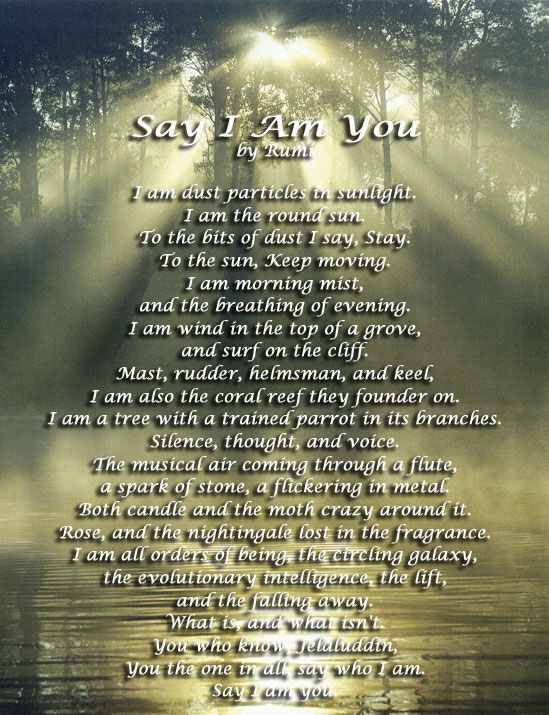
Say I Am With You
Tuesday, March 23, 2010 By Maryam

The Shadow of your Soul
Saturday, March 20, 2010 By Maryam

Where is the shadow of your soul?
It rests silent among the chaos;
it looks for a sparkle of light to be gone;
suddenly, a myriad of joy reflects upon your soul, dismissing the echoes of terrible nights, wondering, wandering, for the perfect flower, the perfect bird, the perfect love.
The shadow awaits, in silence, until you give to your soul the delicious tears, the miracle of tasting the bitterness with joy.
Then, it goes away, waiting to return, to be sheltered in your heart’s lap, until you understand that it is what makes you desire the Light of Lights. Until you understand it is a companion you are aware of, forever in your path.
Do not ignore it, just embrace it. Like the child who has no mother, transform the sadness into laughter, into Love. Do not ignore what is giving you the Desire to attain True Love. After all, it is also a guide, a silent guide that brings you to the contrary way, the way you follow when you Love. Be always thankful to the wrong things that happen in your life, because they are the key to your inner strength. The shadow of your soul follows you, no matter what.
Maryam
A History of Islamic Philosophy
Friday, March 19, 2010 By Maryam
Part of the course syllabus will be focused on Ibn ‘Arabi and his mystical philosophy; Discusses the life and works of Ibn ‘Arabi and Sadr, and his mystical doctrines on wahdat al-wujud and its influences on the later development of both mysticism and philosophy.
ICAS PARAMADINA UNIVERSITY, JAKARTA, INDONESIA
A Mystic Journey - Canada
Friday, March 19, 2010 By Maryam
Saturday March 20. 10:15- 11.
Place:
109 855, rue Sherbrooke Ouest Montréal, QC Canada H3A 2TMore Information: Pavillon Leacock
Osho : The Sufi is not an escapist
Monday, March 15, 2010 By Maryam
Please read this article about the sufi character, it is very beautiful, and important. Via The Mystical Path
Sufi Soul: The Mystic Music of Islam
Monday, March 15, 2010 By Maryam
For hundreds of millions of Sufi followers worldwide, music is at the heart of their tradition and a way of getting closer to God. From the Whirling Dervishes of Turkey to the qawwali music of Pakistan, Sufism has produced some of the world�s most spectacular music celebrated by Muslims and non-Muslims alike. Dalrymple�s film traces the shared roots of Christianity and Islam in the Middle East and discovers Sufism to be a peaceful, tolerant and pluralistic…
International conference on Sufism and peace begins in Pakistan
Monday, March 15, 2010 By Maryam
Delegates from 70 countries are attending the conference which is aimed at promoting the philosophy of Sufism as it can help fight the menace of extremism.
Source: Xinhua
READ MORE
Azam Ali - I Am a Stranger in This World!
Sunday, March 14, 2010 By Maryam

Sufi Music
Sunday, March 14, 2010 By Maryam
Quest for Red Sulphur: The Life of Ibn 'Arabi Claude Addas, Peter Kingsley
Saturday, March 13, 2010 By Maryam
Ebay Auction
Creative Imagination in the Sufism of Ibn 'Arabi (Routledge Library Editions: Islam) (Volume 7) (Hardcover)
Saturday, March 13, 2010 By Maryam
Product Description: In this volume Henry Corbin emphasizes the differences between the exoteric and esoteric forms of Islam. He also reveals that whereas in the West philosophy and religion were at odds, they were inseparably linked, at least during this period, in the Islamic world. A valuable section of notes and appendices includes original translation of numerous Sufi treatises.
Amazon.com
Religious experts explore other faiths
Thursday, March 11, 2010 By Maryam

There are two things people should never to bring to the dinner table: politics and religion. But when four experts of clashing religions converge on grounds to understand one another, the outcome like the attempt, is unparalleled.
Spiritual Heritage
Wednesday, March 10, 2010 By Maryam
Written by Lewellyn Vaughan-Lee, I have thought of sharing it here too.
Peace and Blessings, Maryam.
We live in a culture of religious diversity that is at present experiencing a reawakening of interest in spirituality. If we are to more fully understand what this reawakening might mean, it seems to me that we need to clarify the traditional difference between religion and spirituality, between the exoteric and the esoteric.
Exoteric refers to a religious doctrine or body of knowledge that is accessible to anyone. It does not rely upon one's individual inner experience of the divine or what is sacred. Religious teachings have often emphasized that following religious doctrine is more important than one's individual spiritual experience, and some have discouraged inner experiences altogether.
In contrast esoteric teachings and their practices are usually a way to help the individual have a direct inner experience of the sacred. They are based upon the understanding that there is a world of the spirit that is very different than the purely physical world of the senses. Esoteric studies often involve specific spiritual practices that are quite distinct from religious observances. These practices are a way to access the world of the spirit--leading finally to awaken or be born into this reality that is invisible to our physical eyes.
Spiritual teachings of all cultures tell us that just as we have a physical body, so too do we have a spiritual body. This is the body of our spiritual self. In some Indian traditions it is described as having a series of energy centers, or chakras. In Sufism it is described as a series of chambers within the heart--that just as we have a physical heart we also have a spiritual heart which contains our divine consciousness. In Taoism it is sometimes imaged as a spirit body or light body. Our spiritual body has qualities such as peace, bliss and endless love that are rarely found in our outer lives. What is common to most esoteric traditions is that we can access this spiritual body through specific practices or techniques, meditation, mantra, breathing practices and others.
Many religions have an esoteric core, for example the Jewish Kabbalah, or Sufism which is known as the heart of Islam. Yet, at different times in history religions have banned or persecuted as heresy esoteric teachings and their practitioners. Early Christianity had a known esoteric dimension, for example in the teachings of the Gospel of Thomas that point to an inner spiritual mystery, as in the words of Jesus: "I disclose my mysteries to those who are worthy of my mysteries." Sadly the orthodoxy of the early Church banned the inner, esoteric aspect of Jesus' teachings, and the Gospel of Thomas became heresy, its copies destroyed, until one copy was rediscovered at Nag Hammadi in 1945.
The esoteric, spiritual teachings that can be found within many religions, shamanic and other traditions form part of our spiritual heritage. They remind us that we are not just physical beings in a physical world, but that our lives and also our bodies have a spiritual dimension. We are beings of light as well as flesh and blood. There is a world within and around us to which we can have access that is very different to the physical world. Yet the spiritual and physical worlds are not separate, but interpenetrate and nourish each other.
At this present time there is a hunger for direct inner experience, a need to reclaim our spiritual heritage. While our materialistic culture tries to keep our attention firmly in the physical world of the senses, many of us sense a longing to know this hidden mystery of what it means to be human. And so we are able to turn to the teachings and traditions that have been given to us, whether in yoga, Buddhist meditation, Sufi dhikr or other spiritual practices. It is important to recognize the root of our longing, that we are no longer prepared to live in a purely physical world, but need the living presence of the spiritual. We need to know and be nourished by the invisible world that is within us and all around us. We need to reclaim the mystery and magic of being fully alive.
We also need to confront the specter of death. So many people, knowing only the physical world, remain frightened of death. Religious teachings create a clear division between this life and the afterlife, which may carry the promise of heaven or the threat of hell. Spiritual experience can lift the veils between the worlds, allowing us to glimpse a spiritual reality while we remain present in the physical world. Many people have had near death experiences in which they see a light at the end of a tunnel. Our spiritual heritage can give us access to this light while we are still in this world. This is the light found within the heart, the light of our divine self. It is beautifully imaged in the Gospel of St. Matthew which speaks about the oneness of real inner perception: "If therefore thine eye be single, thy whole body shall be full of light."
Spiritual life can take us beyond death. In Sufism this is called "to die before you die," to awaken to the world of light while still alive in this world. Then you know that there is no such thing as death, or in Jesus' words in the Gospel of Thomas, "Whoever discovers the interpretations of these sayings will not taste death."
Spiritual truth is at the heart of all religions, and yet it is also beyond the divisions that plague our world. It is about the oneness, the love and the light that is within us all, and to which as human beings we can have access. Spiritual teachings and their practices can give us each our own individual experience of this very human reality, help us to live in the light of this oneness rather than stumbling in the darkness of so many divisions. I feel that our present spiritual reawakening is a deep longing, a need to step into this light.
17-24 April: 4th Festival of Sufi Culture in Morocco
Friday, February 26, 2010 By Maryam
The 4th Fez Festival of Sufi Culture will be held from 17 to 24 April in the palaces, riads and Andalusian gardens of the city of Fez around the theme "Mysticism and poetry”.
The festival will , according to the Association of Fes Festival of Sufi Culture, continue to show Morocco as the land of the ancient home of Sufism and promoter of dialogue among cultures, but also as a bridge between the East and the West, symbolized by the mediating role that Morocco has always played, especially in its modern history.
As in previous years, the festival offers a musical program blending various artistic creations of the Sufi world. It will celebrate the Shahi Qawwals of Ajmer Dargah Sharif, who come from India, and the troupe of Chinese music and Sufi songs "Maqamat", Mustafa Zaman Abbasi from Bangladesh, Hussain Al Aadhamy from Iraq, Syria Shaykh Habboush and Jalal Eddine Weiss of France. *
The festival will bring together the Moroccan artist Karima Skalli and the Haj Younis, who will pay tribute to Abu al-Hasan Ash Shusturi.
Other troops famous for Sufi music are also invited to animate the festival evenings. The sumptuous Batha Museum will house the night of Samaa Tariqa Boutchichiyya, Charqawiyya, Darqawiyya, Wazzania and Siqilliyya Khalwatiyya.
Other evenings will also be expected by enthusiasts of Sufi music, including a vigil Samaa Haj Mohammed Bennis and concert Briouel Mohamed, who is accompanied by "great voice" of Samaa Morocco.
At the intellectual level, debate will be animated by personalities from different cultures and religions, academicians, intellectuals, spiritual leaders, politicians, business leaders and actors of civil society, which will meet in the Forum 'Giving Soul to Globalization".
Several other conferences and forums are also in the program.
Source: moroccoboard.com
Musical manna will rain down from a Sufi heaven
Saturday, January 16, 2010 By Maryam
Come, but be careful. That was the advice the composer of Slumdog Millionaire gave to Indians thinking of studying in Australia.
A.R. Rahman said he had not considered cancelling his tour after the attacks and murders of Indians in Australia.
''A lot of my friends' sons [have come] here and they have gone back very happily. They have benefited from Australian studies,'' he said.
Rahman will give a free concert in Parramatta Park tomorrow.
He advised students to take care after dark and avoid areas where drug and alcohol problems were rife, and he called for greater responsibility in the reporting of the murders.
''The media is a great tool but it can also be misused,'' he said. ''Speaking to a lot of people [they say] some of them are racially biased and some are not. But they get painted with the same colour.''
He would not comment on moves by a Hindu militant group in Mumbai, Shiv Sena, to prevent Australian cricketers from playing there until the attacks had ceased.
He believed music could play a role in healing the tensions. ''This concert is about reaffirming the friendship and interest of both people, and I hope this concert brings that.''
Rahman, who shot to international attention with his film soundtrack and its exuberant anthem, Jai Ho, is a practicing Sufi. He converted from Hinduism after meeting a teacher of Sufism, the mystical form of Islam, 20 years ago. He also changed his name, from Dileep Kumar to Allah Rakha Rahman.
''He [the teacher] never told us you have to become a Muslim, but out of interest I started getting inquisitive about stuff,'' he said. Rahman's music is influenced by his beliefs: ''The whole philosophy of Sufi is to give to the universe, to be unconditional. It is like the rain falls on everyone and the sun's rays fall on everyone … So that philosophy has fascinated me and that's what I follow. Music, too, is about giving.''
Rahman has won two Oscars and been nominated for two Grammys. His concert at Parramatta is at 7.30pm tomorrow (today in fact:-) )
Source: The Sydney Morning Herald
Sufism a panacea for all social evils
Saturday, January 16, 2010 By Maryam
Sufism is a panacea for issues related to violence and hatred and an elixir for those who feel inclined to share and promote love, compassion and empathy among mankind for making this world a better place to live. It is the epitome of secularism and the basic premise of a pluralistic society.
These views were expressed by speakers during the valedictory function of a two-day national seminar on ‘Sufism and Sufi Literature’ that concluded at Punjabi University on Friday.
Syed Sarwar Chishti from Gaddi Nashin, Dargah Sharif in Ajmer and H K Dua, Editor-in-Chief of The Tribune were the guests of honour.
Talking of ‘Talibanisation of Islam’, Chishti said militants, who are bent upon destroying the pious fabric of the religion through their virulent and disruptive acts, were the outcome of false indoctrination coupled with ignorance.
“We have to remain vigilant and cautious against spilling over of extremism from across the border as these brutal forces won’t find scarcity of resources to help them in their dastardly mission,” Chishti said.
While assuring the Vice-Chancellor all support in establishing a Sufi Centre, he called upon the media to play a responsible role to help revive a peaceful and congenial atmosphere.
Dua, in his address, said that Sufism provides the most befitting answer to the theory of ‘Clash of Civilizations’.
Rating internal strives as more dangerous than external aggressions, Dua said that various existing denominations have no remedies but people do have. Vice-Chancellor Jaspal Singh reiterated that truthful living was the quintessence of Sufism.
Source: IndianExpress.com
AMIR VAHAB - NAVAEE
Saturday, January 16, 2010 By Maryam
A very beautiful old Persian Sufi Song.
Perhaps someone could translate it for us?

Beloved
Saturday, January 16, 2010 By Maryam
I dance, I am a woman;
I sing, I have a soul;
I spread flowers over our encounter,
and let them fall
over our hearts...
I give you the cup of wine
in whispers
and in sounds of happiness,
in love poems,
and songs that come from heaven.
I sip from this Love
with tears in my eyes,
babbling the name
of the All-Nothing that sees us, with a smile.
We both are looking for the same;
searching, always searching;
and even if we see...
We still prefer to wonder.
Under the stars I find the Beloved
through my earthly beloved.
You feel paradise
through this love that becomes LOVE.
We are children, we are joy,
we are starting to live the real void
reaching ladders and wings and lights
upon us.
Beloved, you take me to The BELOVED.
Maryam

Friday, January 15, 2010 By Maryam
PLEASE HELP HAITI: STATE OF EMERGENCY
Friday, January 15, 2010 By Maryam

Oscar winner plays for peace
Tuesday, January 12, 2010 By Maryam
Amid tension over attacks on Indian students, a musical superstar wants to help, writes Matt Wade.
Can Bollywood rhythms help soothe international tensions? A.R. Rahman, the superstar of contemporary Indian music who created the Oscar-winning soundtrack for the hit movie Slumdog Millionaire, thinks they can.
As fury grows on the subcontinent over attacks on Indians in Australia, Rahman will stage a free concert in Sydney's Parramatta Park on Saturday to "build a bridge of understanding". Rahman suggested the show as a gesture of goodwill.
"This concert is a statement of friendship, peace and love," he says before leaving for Australia.
Rahman's desire to stage the concert underscores how deeply the attacks have been felt across India. He considers it his "duty" as a musician to help promote understanding between both countries.
"The show is to celebrate … music and friendship. I feel a concert is a very spiritual gathering where people from many different backgrounds can come together doing the same thing. It's a great way to make a statement of love and peace."
Rahman's show, which is part of the Sydney Festival, was announced last August after a series of attacks on Indian students in Melbourne and Sydney. The assaults received blanket media coverage in India and damaged Australia's reputation as a safe destination for students.
Tension has flared again in the past fortnight after the violent deaths of two Indians in Australia, including the stabbing murder in Melbourne of former student Nitin Garg. These incidents have made Rahman's visit more poignant.
He hopes the Parramatta show will help break down cultural misunderstandings and boost the morale of tens of thousands of Indians studying in Australia.
"It's not just the music, it is what's behind the music," he says. "I really hope we get a positive response in Australia."
The celebrated score for Slumdog Millionaire won Rahman two Oscars, a BAFTA Award and a Golden Globe last year and introduced him to a global audience. The film's uplifting anthem, Jai Ho, became an international hit, topping the charts in several countries including Australia.
"There is now more recognition for my work," Rahman says. "I can walk into any studio and talk to any artist … I have the freedom to be more choosy and to express what I want to express in my music."
Rahman has achieved hero status in India and his success is symbolic of a new, more internationally oriented and globally influential India. He has fond memories of playing to packed crowds in Sydney and Melbourne in 2005. "They were some of my best audiences," he says. "There was great hospitality … There was a lot of encouragement and a lot of love so that's what forced us to come back again."
Rahman says about 80 people will be involved in Saturday's high-energy concert, which is expected to be one of the highlights of this year's festival.
"It's a showcase of all the stuff I've done for 18 years … It will be packed with lots of exciting things like video, lights and dance. There are a lot of positive things coming together for this and I hope it's a great success."
Even before last year's international triumph, Rahman had experienced huge success in his homeland where film and pop music merge. He started as a session musician and composed jingles for commercials in his home town of Chennai, formerly Madras. Rahman launched his career as a film composer in the thriving South Indian movie industry which produces hundreds of films each year in languages such as Tamil and Telugu.
In 1992 he gained critical acclaim for his score for the film Roja and was soon writing music for Bollywood and beyond. He has written more than 100 film scores, typically churning out five or six a year.
Rahman's film scores and soundtracks have reportedly achieved sales of more than 300 million, making him one of the best-selling recording artists in the world.
A Time magazine critic described him as the ''Mozart of Madras'' and the magazine included Rahman in its list of the world's most influential 100 people last year.
The 44-year-old's personal story reflects India's religious diversity. Rahman's father, a composer, was a Hindu and his mother a Muslim. He was given the Hindu-sounding name - A.S. Dileep Kumar - but converted to Sufism, a mystical and lyrical form of Islam, in the late 1980s and changed his name to Allah Rakha Rahman.
His music has been deeply influenced by his religious experience and Rahman attributes his achievements to divine blessing. "My whole journey in music … has had a spiritual guidance," he says.
Despite his national and international success, Rahman is still based in Chennai and continues to work on South Indian films. He says that working in the Indian film industry has given him great freedom to experiment. ''I often tell directors I want to do this and they say, 'Yeah, go ahead and we'll make sure it works in the movie.' ''
His tens of millions of Indian fans have now come to expect innovation. "The people of India constantly push me to the edge, asking 'What are you going to do next?', so their interest has pushed me to work harder."
Rahman says Indian classical music has provided a base for his composition but he borrows from an eclectic range of styles including pop, folk, rock and hip hop. "I don't like to get typecast," he says.
Rahman believes the success of Slumdog Millionaire has created a bridge between Western and Indian audiences that could lead more people to explore Indian music. The international success of Jai Ho showed that contemporary Indian music can attract an international audience.
"Indian music has potential to have a bigger impact on the world," he says.
A.R. Rahman plays at Parramatta Park on Saturday from 7.30pm. Gates open at noon, and the venue will be closed when it is full.
Source: The Sydney Morning Herald
Heart, self & soul: the Sufi psychology of growth, balance, and harmony
Tuesday, January 12, 2010 By Maryam

II. Opening Your Heart
III. Transforming Your Self
IV. Your Seven Souls
V. Harmonizing Your Seven Souls
VI. The Practices of Sufism: Psychospiritual Therapy
VII. Sheikh and Dervish: Spiritual Guidance in Sufism
VIII. Dropping the Veils
To read the review of this book, you can visit this page.
ORIGINS AND MEANINGS OF THE EIGHT-POINT STAR
Friday, January 08, 2010 By Maryam
-Astrological Origins
- Use in Islam
- Ancient use of Eight-point Star Symbol
-Religious Integration of Symbol
- Use in Ornamentation and Pattern Building
-Mystical Significance
- Breath of the Compassionate
-Conclusion
TO READ ARTICLE VISIT
ORIGINS AND MEANINGS OF THE EIGHT-POINT STAR by SARAH TRICHA