

Sufi Rituals in the Middle East and the Balkans
Wednesday, January 06, 2010 By Maryam
This book offers intimate and moving portraits of Sufism as practiced in five countries. Sufism, the mystical tradition of Islam, is as far from the strident and often violent fundamentalist strain of the religion that has so captured world attention as it is possible to be. Sufis in all parts of the Islamic world are broad-minded, tolerant, and non-violent, their quest only to find and approach God through all means, including poetry, music, and dance. Historian Nicolaas Biegman has been observing and photographing Sufi practice and ritual in different Muslim lands for many years, and here in this collection of extraordinary photographs he feels the pulse of the Sufi experience, with its enormous variety in discipline and exuberance, intellectualism and spontaneity, in Egypt, Syria, Bosnia and Herzegovina, Kosovo, and Macedonia. In accompanying texts he explores what lies behind the rituals, and explains aspects of Sufi life and practice such as the position of women.
Author Biography:
NICOLAAS (NIEK) BIEGMAN holds a Ph.D. in Balkan history, and is an expert on Islam. He has produced a number of photographic books on Egypt, Haiti, Manhattan, and most recently a Sufi community in Skopje (God's Lovers)


Sufism Books
Sunday, December 06, 2009 By Maryam
TITLES:
Sufis of Sindh
Dr. Motilal Jotwani (1986)
Early Turkish Mystics in Turkish Literature (2006)
Memed Faud Koprula
Discourses of Rumi (It is What It is - Fihi Ma Fihi) (1999-2000)
A. J. Arberry
The Persian Mystics: Jalalud Din Rumi (1912)
F. Hadland Davis
The Sufism of Rubaiyat (1908)
Norton F. W. Mazeldin
Life of Omar Al-Khayyami(1905)
J. K. M. Shirazi
Rubaiyat of Omar Khayyam (1900)
Edward FitzGerald
Sufism Omar Khayyam and E. Fitzgerlad (1915)
A. Bjerregaard
Thanks to Academy of Punjab in North America
sufism
tasawwuf
sufi poems
sufi masters
A Glimpse of the Divine
Friday, May 01, 2009 By Maryam
By Karen Armstrong, "The Hope of Sufism" - The Washington Post On Faith - Washington, DC, USA
Sunday, April 26, 2009
Pakistan's chief problems are political and need a political solution. But political malaise and conflict affects people emotionally, imaginatively, in their relationships, desires and aspirations, and often religion gets sucked into a bad situation and becomes part of the problem.
It is not surprising therefore that some Pakistanis have turned to a somewhat rigid form of Islam. Yet on my visits to the country I have found that people are so open, friendly, eager to hear a friendly voice from the West, and to explore new ways of living an Islamic life.
Sufism is a marvelous form of Islam and would do anybody good anywhere. I came across it very early in my career as a religious historian and was especially drawn to its pluralism.
Sufism, the Heart of Islam
Sunday, April 26, 2009 By Maryam
On the evening of April 23rd, 2009, author Sadia Dehlvi was beaming like a happy child in her Nizamuddin East drawing room. Finally, she had her first book, Sufism, The Heart of Islam, clasped tightly in her hands. Earlier in the day, Harper Collins India, Ms Dehlvi's publisher, had sent her a copy of the book hot off the press. Notwithstanding her excitement, The Delhi Walla pestered her for an interview over a cup of green tea.
Ibn Arabi - audio
Saturday, April 25, 2009 By Maryam

From Wikipedia, the Free Encyclopedia
Read by Maryam
To listen the Spanish version, click here
Pearls of Wisdom / Perlas de Sabiduría
Friday, April 17, 2009 By Maryam
I have added a few more articles at the “Pearls of Wisdom” section.
Thanks to: The Sufi
and
via “Foods for thought”
He añadido algunos artículos sobre sufismo en la sección “Pearls of Wisdom”.
Ya Haqq,
Maryam
Paolo Coelho tells Syria’s Forward Magazine he is influenced by mystical Islam brewing in Syria
Sunday, April 12, 2009 By Maryam
“No doubt about it. During my journey and my encounter with Sufism, the books I had read by Paulo’s came to my mind a few times, not the stories themselves but the way he writes them. When I came back and started to use the internet to find articles about Sufism, the more I read the more I felt he has a Sufi heart and soul. And… I love that…”
Here is an article where he tells Forward Magazine how this mysticism has influenced his works.
Love’s Calligraphy
Friday, April 10, 2009 By Maryam
'Enlightened by sight'
Ahmed Darwish reviews the life of one of Egypt's most distinguished calligraphers

Calligraphy may seem to be a luxury, as it requires a skill and takes too much time, especially at a time when most of us spend our days hunched over a keyboard, the nostalgia for beautiful writing is hard to resist.
To read more click here
The Other Islam: Sufism and the Road to Global Harmony (Kindle Edition)
Wednesday, April 08, 2009 By Maryam

From Publishers Weekly
Schwartz, a journalist and convert to Islam, offers Sufism, the mystical branch of Islam, as an aid to the United States' efforts to fight extremism. He provides an incomparable history of Sufism, covering in one short book all the major Sufi saints, schools, and the persecution of Sufis by Wahhabis. Deeply anti-Wahhabi, Schwartz encourages U.S. policymakers to ally with Sufis to undermine the Wahhabi influence. Schwartz believes the Wahhabi philosophy, which is literal and extreme in its interpretation of the Islamic faith, to be the motivation behind Muslim terrorism, with Wahhabi Saudis providing the financing. Wahhabis abhor Sufis for centuries-old traditions they label as idolatrous. Schwartz critiques the Western media for inaccurately dismissing Wahhabi attacks on Sufis, including the insurgency in Iraq, as Sunni-Shia disputes. In reality, Schwartz argues, they are part of the centuries-long Wahhabi campaign to destroy Sufism and moderate Islam. Schwartz's opinion—that Sufis are the natural allies of the U.S. in the ongoing war on terror—is well presented and worth considering. (Sept. 16) ""
Copyright © Reed Business Information, a division of Reed Elsevier Inc. All rights reserved."
Review
Advance Praise for The Other Islam
Stephen Schwartz is internationally known as a serious student of Islam and its mysticism and as a special friend of the Bektashi Sufi order. The Other Islam is an important work that will, I sincerely hope, open the minds of non-Muslims as well as Muslims to the heritage and present reality of spiritual Islam. Let this book help spread the message and enlightenment of Hajji Bektash Veli throughout the world. —H.E. Hajji Dedebaba Reshat Bardhi, World Supreme Head of the Bektashi community
The Other Islam is more than an engaging introduction to Sufism in full. Stephen Schwartz has also sketched a suggestive roadmap for the kind of inter-religious dialogue that can move the world beyond the clash of civilizations to a mutually enriching encounter of noble religious traditions. Schwartz’s Sufi-inspired conviction that it is, finally, God’s world, not one in which nihilism married to distorted monotheism will have the final word, can and should be embraced by serious Jews, Christians, and Muslims alike. —George S. Weigel, Distinguished Senior Fellow, Ethics and Public Policy Center, and biographer of Pope John Paul II
The Other Islam presents a different side of the Muslim world and Islam, at a time when Islam is identified in the West with militancy, violence, radicalism, and terrorism. Stephen Schwartz gives readers a good picture of how we should look at Islam’s full spectrum of doctrines and interpretations, and understand that Jihad can be interpreted and implemented by peaceful and spiritual ways. His contribution to the understanding of the other dimensions of this worldwide religion and culture, especially now, is very significant. We should all wish for a greater role for the various Sufi orders in the socio-political culture of the Muslim world. —Reuven Paz, Director, Project for the Research of Islamist Movements (PRISM) of The Interdisciplinary Center, Herzliya, Israel
This book can be found at www.amazon.com
Hazrat Pir-o-Murshid Inayat Khan
Thursday, April 02, 2009 By Maryam
A beautiful sufi poem by a Sufi Teacher from India:
(To read about his life, just follow this Link)

SNOW
Let Thy knowledge cover my heart
as the snow covers the ground.
Let my heart melt in Thy light
as snow before the sun.
Let my heart show the purity of snow
in the path of righteousness.
Pour on me Thy eternal life
as snow on earth.
Make my heart delighted
by the snowfall of Thy knowledge of truth.
by Hazrat Pir-o-Murshid Inayat Khan (undated)

To read about his life, just follow this Link
A Sufi Prince
Saturday, August 11, 2007 By Maryam

by
Yoginder Sikand
Dara Shikoh, eldest son of the Mughal Emperor of India, Shah Jahan, and heir
apparent to his throne, was born near Ajmer in 1615 C.E.. It is said that before Dara's birth, Shah Jahan had paid a visit to the tomb of the great Chishti Sufi mystic, Hazrat Moinuddin Chishti at Ajmer and there had prayed for a son to be born to him, since all his earlier children had been daughters. Thus, when Dara was born great festivities were held in Delhi, the imperial capital, for the Emperor now had an heir to succeed him to the
throne.
Like any other Mughal prince, Dara's early education was entrusted to maulvis attached to the royal court, who taught him the Qur'an, Persian poetry and history. His chief instructor was one Mullah Abdul Latif Saharanpuri, who developed in the young Dara an unquenchable thirst for knowledge and the speculative sciences, including Sufism. In his youth, Dara came into contact with numerous Muslim and Hindu mystics, some of whom exercised a profound influence on him. The most noted among these was Hazrat
Miyan Mir (d.1635 C.E.), a Qadri Sufi of Lahore whose disciple he later became. Hazrat Miyan Mir is best remembered for having laid the foundation-stone of the Golden Temple of the Sikhs at Amritsar.
After Dara was initiated into the Qadri Sufi order, which he describes in his Risala-i-Haq
Numa as 'the best path of reaching Divinity', he came into contact with several other accomplished mystics of his day, Muslim as well as Hindu, including Shah Muhibullah, Shah Dilruba, Shah Muhammad Lisanullah Rostaki, Baba Lal Das Bairagi and Jagannath Mishra. Dara's close and friendly interaction with them led him to seek to establish bridges of understanding between Sufism and Hindu mysticism.
In pursuit of this aim, Dara now set about seeking to learn more about the religious systems of the Hindus. He studied Sanskrit, and, with the help of the Pandits of Benaras, made a Persian translation of the Upanishads, which was later followed by his Persian renderings of the Gita and the Yoga Vashishta. Throughout this endeavour, his fundamental concern was the quest for the discovery of the Unity of God (tauhid), seeking to draw out the commonalities in the scriptures of the Hindus and the Muslims.
Dara expresses this concern in his Persian translation of the Upanishads, the Sirr ul-Akbar ('The Great Secret') thus:
And whereas I was impressed with a longing to behold the Gnostic doctrines of every sect and to hear their lofty expressions of monotheism and had cast my eyes upon many theological books and had been a follower thereof for many years, my passion for beholding the Unity [of God], which is a boundless ocean, increased every moment. [...] Thereafter, I began to ponder as to why the discussion of monotheism is so conspicuous in India and why the Indian [Hindu] mystics and theologians of ancient India do not disavow the Unity of God, nor do they find any fault with the Unitarians.
Dara's works are numerous, all in the Persian language, only some of which are readily available today. His writings fall into two broad categories. The first consists of books on Sufism and Muslim saints, the most prominent of these being the Safinat ul- Auliya, the Sakinat ul-Auliya, the Risala-i Haq Numa, the Tariqat ul-Haqiqat, the Hasanat ul-'Arifin and the Iksir-i 'Azam. The second consists of writings such as the Majma ul-Bahrain, the
Mukalama-i Baba Lal Das wa Dara Shikoh, the Sirr-i Akbar and his Persian
translations of the Yoga Vashishta and the Gita.
Dara on Sufism
The Safinat ul-Auliya, a biography of several leading Sufi saints, was Dara's first work, composed in 1640 C.E., when he was just 25 years of age. Here he stresses the importance of the Sufi pirs or guides, because, he believes, one can attain knowledge of the mystical path only through the assistance of a spiritual master. In Dara's words, 'God never leaves his people without saints to guide them. [...] Therefore, next to the
prophets, there are no other persons than the saints nearer in the presence of God, the Almighty'. The true saint is a 'perfect guide' (pir-i kamil), for, 'No one is more compassionate and magnanimous, erudite and practical, humble and polite, heroic and charitable than the members of this hierarchy of the saints'.
The Safinat ul-Auliya is Dara's second biography of various Sufi saints. Unlike the Sakinat ul-Auliya, which deals with Sufis of various orders, this book discusses only the Qadri Sufis of India. Dara himself was a Qadri, and as he puts it, 'Nothing attracts me more than this Qadri order, which has fulfilled my spiritual aspirations'. The Qadri order, one of the most popular and widespread of all the Sufi silsilahs, traces its origins to
the Prophet through the twelfth century Sufi and Islamic scholar of great renown, Shaikh Abdul Qadir Jilani of Baghdad. The Sakinat ul-Auliya was completed in 1642 C.E., when Dara was 28 years old, three years after his first meeting with the Qadri Sufi Miyan Mir. In the same year, Dara came into contact with another leading Qadri saint, Mulla Shah Badakshani (d.1642 C.E.), who, like Miyan Mir, exercised a particularly powerful influence on Dara, which is readily apparent in his description of the practices of the Qadris in the Sakinat ul-Auliya.
Dara's next book on Islamic Sufism is the Hasanat ul-'Arifin or 'The Aphorisms of the Gnostics'. It consists of the sayings of 107 Sufis of various spiritual orders. Explaining the objective behind writing the book, Dara says in his introduction:
I was enamoured of studying books on the ways of the men of the Path and had in my mind nothing save the understanding of the Unity of God; and before this, in a state of ecstasy and enthusiasm, I had uttered some words pertaining to sublime knowledge, because of which certain bigoted and narrow-minded people accused me of heresy and apostasy. It was then that I realised the importance of compiling the aphorisms of great believers in the Unity of God and the sayings of saints who have, hitherto, acquired
knowledge of Reality, so that these may serve as an argument against those who are really imposters.
In the Hasanat ul-'Arifin, Dara bitterly criticises those self-styled 'ulama who, ignoring the inner dimension of the faith, focus simply on external rituals. His critique is directed against mindless ritualism emptied of inner spiritual content, and he challenges the claims of the 'ulama who would readily trade their faith for worldly gain. Thus, he
says:
May the world be free from the noise of the Mulla
And none should pay any heed to their fatwas.
As for those 'ulama who claim to be religious authorities but have actually little or no understanding at all of the true spirit of religion, Dara writes that, 'As a matter of fact, these are ignoramuses to themselves and learned to the ignorant', and adds the following couplet:
Every prophet and saint suffered afflictions and torments,
Due to the vicious and ignominious conduct of the mulla.
Two short, yet important, works of Dara on the various stages and practices associated with the Sufi path are the Tariqat ul-Haqiqat and the Risala-i Haq Numa. The former consists of both prose as well as poetry. It begins with a prologue containing the praises of God and His Omnipotence and His All-Pervasiveness. Thus, Dara says, referring to the Divine:
You dwell in the Ka'aba and in Somnath [a famous Shaivite Hindu temple]
And in the hearts of the enamoured lovers.
The text goes on to discuss the thirty stages (manazil) on the Sufi path, the first of which is detachment from the materialistic world and the last of which is realisation of the Truth. Broadly the same theme is discussed in the Risala-i Haq Numa, where the seeker (salik) is shown as starting from the Alam-i Nasut or 'The Physical Plane', and, passing through various stages, finally reaching the Alam-i Lahut or 'the Plane of Absolute Truth'. Some of the physical exercises employed by the Sufis that are described in the Risala-i Haq Numa are shown by Dara to be similar to those used by the Hindu Tantriks and Yogis. These include astral healing and concentration on the centres of meditation in the heart and brain. Further, he suggests that the four planes through which the Sufi seeker's journey takes him-Nasut , Jabrut, Malakut and Lahut-correspond to the Hindu concept of the Avasthanam or the four 'states' of Jagrat, Swapna, Shushpati and Turiya.
One of the most intriguing works of Dara's is his collection of poems, the Diwan, also known as the Iksir-i 'Azam. Some of the verses from the Diwan, given below, suggest the train of Dara's mystical thought:
On Monotheism [tauhid]
*
Look where you can, All is He,
God's face is ever face to face.
*
Whatever you behold except Him is the object of your fancy,
Things other than He have an existence like a mirage.
The existence of God is like a boundless ocean,
People are like forms and waves in its water.
*
Though I do not consider myself separate from Him,
Yet I do not consider myself God.
Whatever relation the drop bears with the ocean,
That I hold true in my belief, and nothing beyond.
*
We have not seen an atom separate from the Sun,
Every drop of water is the sea in itself.
With what name should one call the Truth?
Every name that exists is one of God's names.
On Divine Love
*
O Thou, from whose very name rains Love abundant!
And from your message rains Love!
Whoever passes through Your street realises
That indeed from the very door to the terrace of Your house rains l love!
On the Mystical Path
Turn to none except God,
The rosary and the sacred thread are but only a means to an end.
*
All this piety is conceit and hypocrisy,
How can it be worthy of our Beloved?.
*
Kingship is easy, acquaint yourself with poverty,
Why should a drop become a pearl when it can transform itself into an
ocean?.
*
Hands soiled with gold begin to stink,
How awful is the plight of the soul soiled with gold!
Day and night you hear of people dying,
You, too, have to die. How strange is your behaviour!.
*
The more a traveller is unencumbered,
The less he feels worried on his journey.
You, too, are a traveller in this world,
Take this as certain, if you are wakeful.
Drive egoism away from you,
For, like conceit and arrogance, it is also a burden.
So long as you live in this world, be independent,
The Qadri has warned you!
*
Whoever recognised this, carried the day,
He who lost himself, found Him.
And he who sought Him not within his own self,
Passed away, carrying his quest along with him.
The Qadri found his Beloved within his own self,
Being himself of good disposition, he won the favour of the Good.
*
To whatever object you may turn your face, He is in view,
Are you blind, for why do you assign Him to yourself?
Dara On The Religious Systems of the Hindus
Dara wrote extensively on the religious systems of the Hindus, following in the tradition of several Muslim mystics and scholars before him. Like several Sufis before and after him, he saw the possibility of some religious figures of the Hindus having been actually been prophets of God, and certain Hindu scriptures as having been of divine origin. Thus, for instance, he writes in the Sirr-i Akbar that a strong strain of monotheism may be discerned in the Vedas and opines that the monotheistic philosophy of the Upanishads may be 'in conformity with the Holy Qur'an and a commentary thereon'.
In his quest for an empathetic understanding of the Hindu religious systems, Dara spent many years in the study of Sanskrit, and for this purpose employed a large number of Pandits from Benaras. Several contemporary Sanskrit scholars praise him for his liberal patronage of the
language. Prominent among these was Jagannath Mishra, who, it is said, was once weighed against silver coins at Shah Jahan's command and the money given to him. He was the author of the Jagatsimha, a work in praise of Dara, and of the Asif Vilasa, a treatise written in praise of Asif Khan, brother of Nur Jahan, wife of Shah Jahan. Other Sanskrit scholars who were patronised by Dara included Pandit Kavindracharya, who was granted a royal pension of two thousand rupees, and Banwali Das, author of a historical work on the kings of Delhi from Yudhishtra, a key figure of the epic Mahabharata, to Shah Jahan, for which he was honoured by Shah Jahan with the title of Sarvavidyanidhana.
The most well-known of Dara's several works on the religious sciences of the Hindus is his Majma ul-Bahrain ('The Mingling of the Two Oceans'). Completed when Dara was forty two years old, this book is a pioneering attempt to build on the similarities between Sufism and certain strands of Hindu monotheistic thought, and it is these two that the 'two oceans' in the book's name refer to. He describes this treatise as 'a collection of the truth and wisdom of two Truth-knowing groups'. It is, in terms of content, rather technical, focusing on Hindu terminology and their equivalents in Islamic Sufism. The basic message that this book conveys is summed up in Dara's own words thus: 'Mysticism is equality', and, he adds, 'If I know that an infidel, immersed in sin, is, in a way, singing the note of monotheism, I go to him, hear him and am grateful to him'.
The Majma-ul Bahrain is divided into twenty-two sections, in each of which Dara seeks to draw out the similarities between Hindu and Sufi concepts and teachings. Thus, for instance, the Hindu notion of Mukti, he says, is identical with the Sufi concept of Salvation, denoting the annihilation (fana) of the self in God. Or, for example, the Sufi concept of 'ishq (Love) is said to be identical with the maya of the Hindu monotheists. From Love, says Dara, was born the 'great soul', alternately known as the soul of Muhammad to the Sufis, and Mahatman or Hiranyagarba to the Hindus.
Dara's translation of certain Hindu scriptures into Persian represents a landmark in the process of developing bridges of understanding between people of different faiths in medieval India, in which the Sufis played the leading role. One of Dara's earliest attempts at translation was his rendering of the Gita into Persian. Keenly interested as he was in the philosophy of Yoga, Dara also had the Yoga Vashishta, one of the earliest Sanskrit texts on Yoga, translated into Persian.
Dara established close and cordial relations with mystics from various backgrounds. Among these were several jogis and sadhus, about some of whom Dara also wrote. One such sadhu was Baba Lal, follower of the renowned Sufi-Bhakti saint Kabir and founder of a small monotheistic order named after him as the Baba Lalis. Many of the teachings of this sect can be traced to a distinct Sufi influence. A summary of these teachings is to be found in Dara's Makalama Baba Lal wa Dara Shikoh, which consists of seven long conversations between the Baba and Dara held in Lahore in 1653 C.E.
These seven discourses were composed originally in Hindawi, and were later translated into Persian by Dara's chief secretary, Rai Chandar Bhan. As in the case of Dara's translation of the Yoga Vasishta, this text focuses particularly on certain similarities in the teachings of Hindu and Muslim mystics.
The great interest that Dara had in exploring monotheistic strands in Hindu philosophy led him, finally, to translate fifty-two Upanishads into Persian. The text that he prepared, the Sirr ul-Akbar ('The Great Secret') was completed in 1067 A.H. / 1657 C.E.. Here, he opines that the 'great secret' of the Upanishads is the monotheistic message, which is identical to that on which the Qur'an is based.
Dara then proceeds to detail the purpose behind translating the Upanishads. He writes that in the year 1050 A.H. he visited Kashmir, where he met Hazrat Mullah Shah, whom he describes as 'the flower of the Gnostics, the tutor of the tutors, the sage of the sages, the guide of the guides, the Unitarians accomplished in the Truth'. Thereafter, he says, he was filled with a longing to 'behold the Gnostics of every sect and to hear the lofty expressions of monotheism'. Hence, he says, he began his search for monotheism in other scriptures as well, including the Torah of the Jews (Taurat), the Gospels of Jesus (Injil) the Psalms of David (Zabur), and, in addition, the books of the ancient Hindus. He notes with approval the fact that certain Hindu 'theologians and mystics' ('ulama-i zahiri wa batini) actually believe in One God, but laments that 'the ignoramuses of the present age', who claim to be authorities in matters of religion, have completely distorted this fundamental truth. His search for traces of monotheism in the religious systems of the Hindus stems, he says, from his faith in the Qur'an, which states that God has, from time to time, sent prophets to all peoples to preach the worship of the One.
Accordingly, says Dara, he travelled to Benaras in 1067 A.H., where he assembled several leading Sanskrit Pandits to translate the Upanishads, in an effort to draw out from the scriptures of the Hindus the hidden teachings on monotheism which are, he says, 'in conformity with the Holy Qur'an'. Having explored the teachings of the Upanishads, he writes that they are 'a treasure of monotheism', although, he notes, 'very few are conversant with this, even among the Hindus'. Hence, he says, there is an urgent need to bring to light this 'Great Secret' so that the Hindus can learn the truth about monotheism as contained in their own scriptures and, in addition, Muslims, too, can be made aware of the spiritual treasures that the Upanishads contain. He goes so far as to accord the Upanishads, in their original forms, the status of divinely revealed scriptures, claiming that the Qur'anic verse which speaks about a 'protected book', which 'none shall touch but the purified ones' [Qur'an:LVI, 77-80] literally applies to them, because some of the verses of the Qur'an are to be found in their Sanskrit form therein.
Dara's Death
The Emperor Shah Jahan's serious illness in l657 C.E. was the signal of a war of succession among his sons. Aurangzeb grabbed the throne in 1658, and had his father imprisoned in the fort at Agra, where he died eight years later. He then ordered the execution of Dara, who, as Shah Jahan's eldest son, was considered to be the rightful heir to the throne. Although the conflict between the two may actually have been, at root, political, it was sought to be given a religious garb. Dara was accused by Aurangzeb and some 'ulama attached to the royal court of infidelity and heresy. Accordingly, he was executed under a royal decree issued by Aurangzeb in 1659 C.E.. He lies buried, a forgotten hero, in a nondescript grave in the tomb complex of the Emperor Humayun in Delhi.
Source: http://www.the-south-asian.com/March2005/Dara_Shikoh_Spirituality.htm
sufism
tasawwuf
sufi poems
sufi masters
The King, the Sufi and the Doctor
Wednesday, April 11, 2007 By Maryam
Once upon a time, a king of Tartaria went to fish with his courty noble companions.
On their way they crossed an abdal (a sufi errant, a "transformed") who claimed with a loud voice:
-The one who gives me a hundred dinars will be retributed with a very useful advice.
The king stopped and said:
-Abdal, what useful advice will you give me in exchange of the hundred dinars?
-Sir, first of all give the order to be given to me the hundred dinars, and as soon I will immediately give you advice - replied the abdal.
So did the king, waiting for something really extraordinary. But the dervish just said:
-My advice is as follows: "Never start a thing without first thinking about its outcome."
After having heard this, the noble men and other people there started laughing willingly, and they spoke about how smart the dervish was when he asked to have his money in advance.
-You have no right to laugh - the king objected - of this excellent advice that the abdal has just given us. Certainly, none of you ignore the fact that it is necessary to think before making anything. But we all make the mistake not to do it, and this has very tragic consequences. Therefore I value greately the dervish's advice.
Proceeding in accordance to his words, the king decided to always remember such advice, and have it always present; he even ordered to have it written in gold letters on the walls of his palace as well as on his silver tray.
Some time later, an intriguing and ambitious courtisan conceived the idea to kill the king. For this purpose, he extorted the royal doctor with the promise to name him prime minister in exchange of his services: to introduce inside the king's arm a poisoned lance.
When the moment came, it was necessary for the doctor to take the silver tray and put it under the king's arm, in order to take his blood as a proof.
The doctor could not stop reading what was written on that silver tray: "Never start a thing without first thinking about its outcome."
After having read this, the doctor realized that if he did what the courtesan thought of, and if he took possession of the throne,, it would be quite possible that the courtesan would order to hang him immediately, so that the pact would not be accomplished.
The king, feeling that the doctor seemed lost in his thoughts, asked what was going on.
The doctor confessed immediately.
The courtesan was made prisoner, and the king asked the noblemen and courtesans that were present the day the abdal gave his advice:
-And what now? Are you still laughing at the dervish?

tasawwuf
sufi stories
sufi masters
Powered by ScribeFire.
Master of the Jinn, by Irving Karchmar
Sunday, July 10, 2005 By Maryam
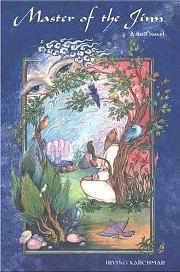 Considered by some Amazon.com reviewers as a "Masterpiece of Modern Islamic Mysticism" and "Awe Inspiring Mystical Adventure", Master of the Jinn, written by Irving Karchmar is a spiritual book which brings wisdom and hidden truths to those mystics (from any religion and thought) through didactic means, as well as parables, imagination, and above all, treasures covered with simplicity. I have personally read some excerpts from this book, and the truth is, I saw a lot of my personal struggle, my discoveries, reflected all through these lines.
Irving Karchmar, the 59 year old author of Master of the Jinn, holds a Masters degree in Philosophy from DePaul University in Chicago. He has been a poet, writer, editor and publisher for many years, and a darvish of the Nimatullahi Sufi order since 1992. He now lives in Sag Harbor, New York, where he is currently at work on his second novel, a sequel entitled Tale of the Jinn.
Here are two audio excerpts from the book. The first one belongs to the Book 1, Chapter 1, entitled "The Master". The second one is a story called "The Judgement of God. A Sufi Tale".
Gather and enjoy.
Master of the Jinn. A Sufi Novel by I. Karchmar. Excerpts
MP3
The Judgement of God . A Sufi Tale, by Irving Karchmar
MP3
Related to the author:
"Masters of the Jinn" homepage
"Sufi Blog"
Categories:
sufi books
sufism
tasawwuf
sufi masters





