al-Qushayri and his Treatise. The Moment (waqt)
Thursday, July 07, 2005 By Maryam
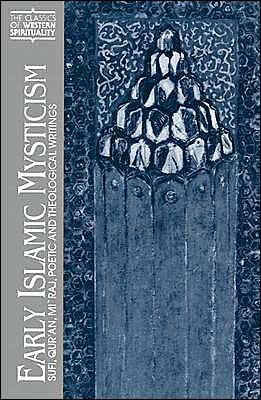
The following is an excerpt from the book "Early Islamic Mysticism", by Michael A. Sells, when the author introduces us to al-Qushayri in a chapter entitled "Interpreting Mystical Expressions from the Treatise".
Who was Qushayri and what is the importance of his metaphysical study "the Treatise"? Here is the introduction written by Sells and a short excerpt belonging to chapter III of "the Treatise":
Interpreting Mystical Expressions from the Treatise
In refinement of style, ability to combine a searching discussion of the most difficult concepts with a lucid and readable exposition and combination of precise analysis with theatrical anecdote, few works rival the famous Treatise of Qushayri.
'Abd al-Karim ibn Hawazin al-Qushayri (d. 465H/1074CE) was born near Nishapur in the Khurasan area of what is present day Iran. He received the full Islamic education of the time, memorizing the Qur'an, studying Islamic law (fiqh) and Ash'arite theology, and becoming a disciple to the Sufi master Abu 'Ali ad-Daqqaq (d. 378/988) and Sulami (d.412/1021). Qushayri's Treatise became so popular that it is known simplyas the Qushayriyyan Treatise or the Treatise. It is perhaps the most popular classic work on Sufism, admired for its subtlety, acuity, and clarity.
Presented here is section three of the Treatise, the section on key Sufi terms and concepts. The intricate discursive texture of the section is immediately apparent. The analysis of each major concept is woven around the sayings of earlier Sufis. Qushayri is particularly fond of unattributed proverbs, introduced by phrases such as "they say", "some say", or "someone said."
..................
Realized masters emply the term "moment" (waqt) to refer to the relation between the anticipation of an event and the event's actual occurrence.
Conversely, the actual occurrence can be considered the moment of the anticipated occurrence. You say, for example: "I'll meet you at the beginning of the month." The meeting is an anticipation. The beginning of the month is actual occurrence. Thus, the beginning of the month is the moment of the meetings.
I heard the teacher Abu 'Ali ad-Daqqq, God's mercy upon him, say: "The moment is what you are in. If you are in the world, your moment is the world. If you are in the afterworld, your moment is the afterworld. If you are in happiness, your moment is happiness. If you are in sorrow, your moment is sorrow." By that he means that the moment is that which dominates a person.
Some people mean by the moment the time in which a person happens to be. Some of the folk say that the moment is between two times, between the past and the present.
They call the Sufi "a son of his moment" (ibn waqtihi), meaning that he is completely occupied with the religious obligation of his present state, carrying out what is demanded of him at the time. It is said that one who embraces poverty has concern neither for the moment past nor for the moment to come. He is concerned only with the present moment in which he finds himself. They also say: "to be preocuppied with a past moment is to lose a second moment."
By moment they can also mean that which happens to them through the dispositions of the real that come upon them without any choice on their part. They say: "So and so is in the power os his moment," that is, he surrenders to whatever comes over him, without his own will, from the unknown. This meaning applies only for those things that are not under God's prophetically given command or injunction. To neglect or to consign to providence what has been commanded or to neglect the complete carrying out of the command is to be outside the faith.
They say: "The moment is a sword", that is, just as the sword is cutting,so the moment prevails in what the real brings to pass and completes. It is said: "The sword is gentle to the touch, but its edge cuts. Whoever handles it gently is unharmed. Whoever treats it roughly is cut." Similarly for the moment, whoever submits to iis decreee is saved, and whoever opposes it is thrown over and destroyed. In this regard they composed the following verse:
Like a sword - if you handle it gently
its touch is gentle,
but its edges, if you treat it roughly
are rough.
When the moment favors someone, the moment for him is just a moment. When the moment opposes someone, the moment for him is loathing.
I heard my teacher Abu 'Ali ad-Daqqaq say: "The moment is a file. It files you down without effacing you." He means that were it to efface you and make you pass away, you would be -in your passing away- liberated.
However, the moment takes from you without entirely annihilating you.
He recited in this regard:
Every day that passes
takes part of me,
leaves my heart a portion of loss,
and passes away.
He also recited:
Just as the people of fire
when their skin is well roasted
have prepared for their wretchedness
new skin.
And with similar meaning:
No one truly dies
who finds rest in dying.
To truly die
is to live your death.
sufism
tasawwuf
sufi poems
sufi masters


ABU ‘L-FAYD DHU ‘L-NUN IBN IBRAHIM AL-MISRI. Second Chapter Risâla al-Qusháiri (First Part) Cont.
Sunday, October 10, 2004 By Maryam

Dhu 'l-Nun said: "A sign that shows one loves Allah is when one loves the Beloved (pbuh) under the Beloved way of being (Ajlâq) imitating The Beloved, following the precepts and following the customs and attitudes (Sunna).
On one occasion he was asked who were the worse people and he replied:" those who don't know the Path to Allah and those who knowing it don't let others know about it".
One maghrebian assisted to Dhu 'l-Nun assembly (máÿlis) and asked him: "Oh, Abu 'l Faid, what was the reason for your Return (Tawba) towards Allah?"
Dhu 'l-Nun answered: "A surprising story that you could not bear (that you could not believe)".
The maghrebian insisted: "For the sake of the One you serve! Tell us this story!" And Dhu 'l-Nun said:
"One day I left Cairo to visit a certain village, and on the desert road, tiredness came to up to me, so I went under a tree's shade to sleep for a while. When I opened my eyes, there was a blind skylark that had fell down its nest. Suddenly, the ground opened and from it appeared two bowls, one in gold and the other in silver; the first one had sesame seeds and the other one water, and the skylark ate from the seeds and drank from the silver bowl.
Then I exclaimed:" Stop this! I come back to Allah", and I remained at the door until Allah accepted me.
Dhu 'l-Nun said: "Knowledge doesn't live in a stomach that is full of food. He was asked about the Tawba (the return to Allah) and he replied: "For most people, t is to leave back their awkwardeness. For a few only, it is to abandone any kind of disregard."
Picture of Tomb of Dhû l-Nûn al-Misrî
Ibrâhîm ibn Ádham. Continued from Part One "The First Sufis". Risala al-Qushayri
Monday, October 04, 2004 By Maryam
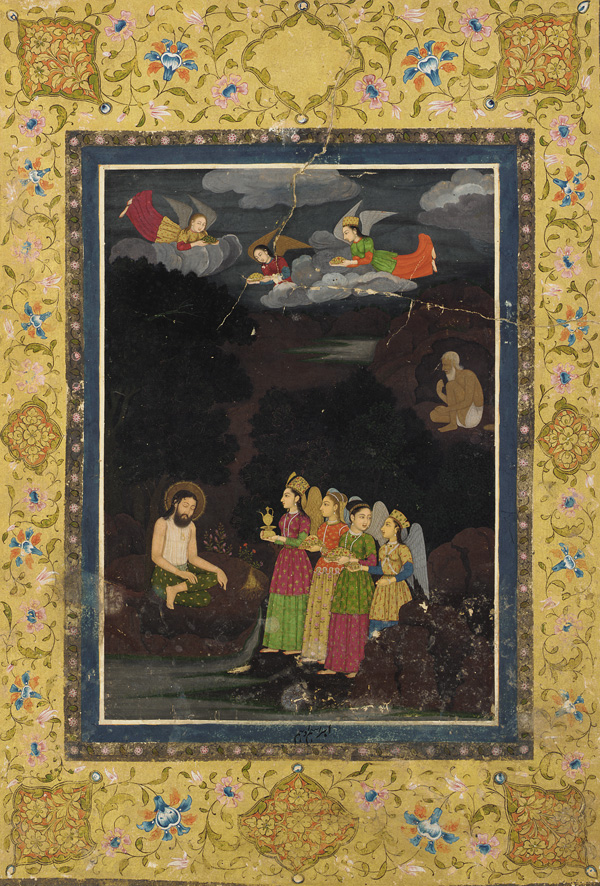
late 17th century
Mughal
Color and gold on paper
H: 23.8 W: 16.9 cm
India
Gift of Charles Lang Freer, F1907.198
Since the first moment he decided to follow the Sufi path, his only sustenance came from his work. He dedicated his working time to gather seeds, working the field and gardening. One day, while he was on the desert, he came to meet a man who told him the "Uppermost name of God" (al-Ism al-Á‘zam), and he invoked this Name. And then, he saw Al-Jidr, who told him that it was prophet David ((Dâwûd) who had transmitted it. Ibrâhîm ibn Ádham was very severe in regards to the practice of Wára‘, consisting in the scrupules that divert muslims from the Harâm, refraining from all the things that the Sharî‘a considers illicit, and even many licit actions (Mubâh), Ibrâhîm refrained from doing them from fear that it would make him forget his dedication to Allah. He used to say: "Be your feed the fruit of your honest work, and do not worry if your prayers in the night are not many or if you do not fast with the intensity that you would like..."
One of his invocations was "Allahuma, transport me from the humiliation that represents the fact of disobeying you to the pride for submiting to you." Ibrâhîm ibn Ádham said one day to a man who was doing the circular steps (Tawâf) around the Ka'aba: "You will not attain the degree of the Sâlihîn until you have stepped on six slopes: the first one means that you must close the door to happiness and open the one to calamities; the second meand that you must close the door to the pride and open the door to humility; the third means that you must close the door to rest and open the one to severity; the fourth means that you must close the door to sleep and open the one to insomnia; the fifth is that you must close the door to weatlh and open the one to poorness; the sixth means that you must close the door to hope and open the one that prepares you to embrace death.
One day he was taking care of a vineyard and a soldier passed by Ibrâhîm ibn Ádham and asked him to give him a bunch of grapes. " The owner of this vineyard put me to care for it", Ibrâhîm replied, and the soldier took out his whip and started floggin him. Ibrâhîm took all that pain saying: "Yes, yes!, whip this slave's face who never stops serving his Lord." Finally the soldier stopped when he got tired and let Ibrâhîm in peace.
Sahl said that once he travelled with Ibrâhîm ibn Ádham. Sahl felt ill and Ibrâhîm spent all his money to care after him. While Sahl was deluring, he asked for something and Ibrâhîm sold his donkey in order to get the money and buy what Sahl asked for. When Sahl recovered, he asked Ibrâhîm where the donkey was, as they were getting ready to pursue their trip. "I sold it", Ibrâhîm replied. "Then, how are we going to travel now?", Sahl asked. And then Ibrâhîm put Sahl on his shoulders and walked for three journeys this way.
The First Sufis. From 2nd chapter Risâla al-Qusháiri. Part One.
Sunday, October 03, 2004 By Maryam
"You must know that among the first muslims there was nothing that could distinguish them more but the fact of having been with the Prophet (pbuh), and those who took a special mention among them were called Sahâba (companions) as they had personally met Rassulullah and had enjoyed from his company (suhba). And then, the second generation of muslims used as title of privilege for those who were best among them Tâbi‘în, Pursuers, who had recieved directly the teachings from the Sahaaba. As for the third generation, the chosen name was Tâbi‘î t-Tâbi‘în, Pursuers of the Pursuers, or Followers of the Followers, meaning those who had the teaching of the Tâbi‘în regarding Islam. And, the group of these three generations receives the name Sálaf, our ancestors in Islam.
After these three generations, Sálaf, and once Islam had expanded through the lands, sincerity and compromise of the Dîn were still very present in some, and those people were called Çuhhâd, Ascetics.
But Islam continued its expansion and started to suffer its first divisions and some parties became to follow paths that were getting far from the source of Islam, who liked to show off how many Çuhhâd were among their groups. Therefore, the people of the Sunna, started changing that word to another more according to those who followed the original teachings of Sidnâ Muhammad (pbuh) and this name , this word to designate these kind of people became Tasáwwuf, with the derived name Sûfi. Since then, it is this word the one that has continued to designate those who keep the Oneness and deffend their hearts from any kind of carelessness.
To be continued part One