Sufism and Peace
Wednesday, April 18, 2012 By Maryam
This article talks about how scholars and educationists in India are urging the government to hold an international conference on Sufism to promote the message of peace and love as well as an invitation to people from all over the world to attend the conference in which it would be asked the creation of a Sufi University for research.
Call to hold international moot on Sufism
The Breath of the Merciful
Sunday, January 30, 2011 By Maryam
The Breath of the Merciful is understood as the cosmic dynamic that vitalizes the many in the One. It is the ever-present ‘Breathing’ that makes it possible for this infinite universe of duality to come into being while never being other than the nondual essence of the One. Seeing the nature of this dynamic gives us a chance to intuitively understand how there can simultaneously be the one indivisible essence of the Realand the endless proliferation of phenomena. This understanding, if it occurs, is not conceptual and is not simply a metaphysical nicety. ‘Getting’ the relation between the relative and the absolute is at the heart of all experiences of spiritual awakening.
This is a very interesting article about the Mysticism of Music that I invite you to read


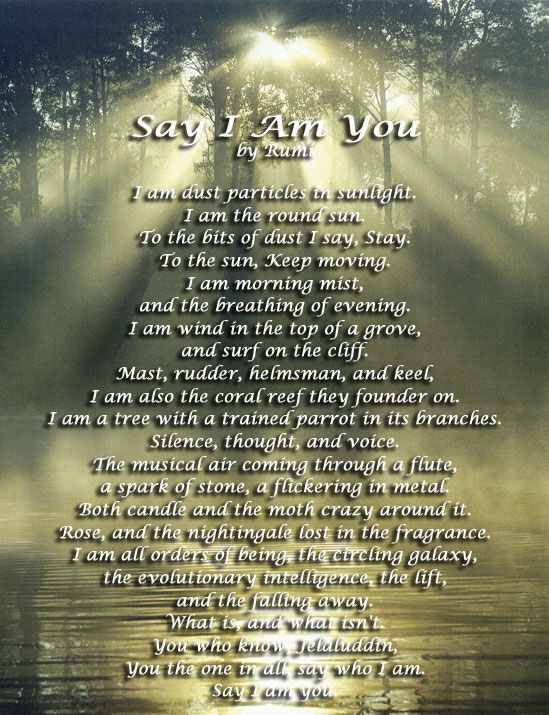
Say I Am With You
Tuesday, March 23, 2010 By Maryam

Sufi Soul: The Mystic Music of Islam
Monday, March 15, 2010 By Maryam
For hundreds of millions of Sufi followers worldwide, music is at the heart of their tradition and a way of getting closer to God. From the Whirling Dervishes of Turkey to the qawwali music of Pakistan, Sufism has produced some of the world�s most spectacular music celebrated by Muslims and non-Muslims alike. Dalrymple�s film traces the shared roots of Christianity and Islam in the Middle East and discovers Sufism to be a peaceful, tolerant and pluralistic…
17-24 April: 4th Festival of Sufi Culture in Morocco
Friday, February 26, 2010 By Maryam
The 4th Fez Festival of Sufi Culture will be held from 17 to 24 April in the palaces, riads and Andalusian gardens of the city of Fez around the theme "Mysticism and poetry”.
The festival will , according to the Association of Fes Festival of Sufi Culture, continue to show Morocco as the land of the ancient home of Sufism and promoter of dialogue among cultures, but also as a bridge between the East and the West, symbolized by the mediating role that Morocco has always played, especially in its modern history.
As in previous years, the festival offers a musical program blending various artistic creations of the Sufi world. It will celebrate the Shahi Qawwals of Ajmer Dargah Sharif, who come from India, and the troupe of Chinese music and Sufi songs "Maqamat", Mustafa Zaman Abbasi from Bangladesh, Hussain Al Aadhamy from Iraq, Syria Shaykh Habboush and Jalal Eddine Weiss of France. *
The festival will bring together the Moroccan artist Karima Skalli and the Haj Younis, who will pay tribute to Abu al-Hasan Ash Shusturi.
Other troops famous for Sufi music are also invited to animate the festival evenings. The sumptuous Batha Museum will house the night of Samaa Tariqa Boutchichiyya, Charqawiyya, Darqawiyya, Wazzania and Siqilliyya Khalwatiyya.
Other evenings will also be expected by enthusiasts of Sufi music, including a vigil Samaa Haj Mohammed Bennis and concert Briouel Mohamed, who is accompanied by "great voice" of Samaa Morocco.
At the intellectual level, debate will be animated by personalities from different cultures and religions, academicians, intellectuals, spiritual leaders, politicians, business leaders and actors of civil society, which will meet in the Forum 'Giving Soul to Globalization".
Several other conferences and forums are also in the program.
Source: moroccoboard.com
Sufism a panacea for all social evils
Saturday, January 16, 2010 By Maryam
Sufism is a panacea for issues related to violence and hatred and an elixir for those who feel inclined to share and promote love, compassion and empathy among mankind for making this world a better place to live. It is the epitome of secularism and the basic premise of a pluralistic society.
These views were expressed by speakers during the valedictory function of a two-day national seminar on ‘Sufism and Sufi Literature’ that concluded at Punjabi University on Friday.
Syed Sarwar Chishti from Gaddi Nashin, Dargah Sharif in Ajmer and H K Dua, Editor-in-Chief of The Tribune were the guests of honour.
Talking of ‘Talibanisation of Islam’, Chishti said militants, who are bent upon destroying the pious fabric of the religion through their virulent and disruptive acts, were the outcome of false indoctrination coupled with ignorance.
“We have to remain vigilant and cautious against spilling over of extremism from across the border as these brutal forces won’t find scarcity of resources to help them in their dastardly mission,” Chishti said.
While assuring the Vice-Chancellor all support in establishing a Sufi Centre, he called upon the media to play a responsible role to help revive a peaceful and congenial atmosphere.
Dua, in his address, said that Sufism provides the most befitting answer to the theory of ‘Clash of Civilizations’.
Rating internal strives as more dangerous than external aggressions, Dua said that various existing denominations have no remedies but people do have. Vice-Chancellor Jaspal Singh reiterated that truthful living was the quintessence of Sufism.
Source: IndianExpress.com
AMIR VAHAB - NAVAEE
Saturday, January 16, 2010 By Maryam
A very beautiful old Persian Sufi Song.
Perhaps someone could translate it for us?

Kudsi Erguner on Ney and Sufism
Thursday, January 07, 2010 By Maryam

Kudsi Erguner on Ney and Sufism
Shah Shahidullah Faridi
Saturday, January 02, 2010 By Maryam

Hazrat Shah Shahidullah Faridi (1915-1978) embraced Islam after reading "Kahful Mahjub" (The Unveiling of the Veiled), the classical treatise on Sufism written by the famous saint Hazrat Ali bin Uthman al Hujweri. Though having been born and raised in a wealthy English family he left his home in search of a Sufi shaikh. In India, he eventually met the Chishti Sabri shaikh, Syed Zauqi Shah and pledged allegiance to him. At forty years of age, the responsibilities of spiritual succession were entrusted to him. He lived in Karachi for about thirty years until he died on Ramdhan 17th in 1978. He was well-known among the local population as a dedicated servant to the common people, and he died in relative obscurity except in the Sufi community in Pakistan. His followers built a moseluem (mazar) to honor his burial site which is located at Sakhi Hassan in Karachi. The mazar area also has a mosque and a graveyard in the complex. His work has attracted the attention recently of another English Muslim convert, Timothy Winter, a.k.a. Abdal Hakim Murad. Hazrat Shahidullah was fluent in many languages and his discourses appealed to various ethnic groups across Pakistan. Though the number of his followers are in the few hundreds they come from all four provinces of Pakistan. His successor is Hazrat Siraj Ali who continues the Sabri Chisti lineage in Karachi.
His brother, who had also read Kashf'ul Mahjub and had accompanied him in his worldwide spiritual quest, also became a Muslim and followed Sufism. Shaykh Faridi's brother is buried within the famed Mausoleum of the Sufi Saint of Lahore, Pakistan - Ali Hajweri - known locally as Data Sahib or Data Ganj Baksh.
Shah Shahidullah Faridi was a renowned writer on spiritual matters, and was regarded as having great clarity and insight. One of his most famous books is Inner Aspects of Faith.
He also compiled Part Two of "Tarbiatul Ushaq" ("The Training of Divine Lovers"), Syed Mohammad Zauqi Shah, 1425/2004, pub. A.S.Nordeen, Kuala Lumpur, ISBN 983065185-1
Main source: A brief biography of his, published recently in Urdu called "Talash e Haqq rudad." by Ahmed Ghazali Shaheedi,printed by M. Naeem Hashmi, Saudabad Malir Colony Karachi
More information Here
PAL plans conference on Sufism
Saturday, January 02, 2010 By Maryam
ISLAMABAD (APP) - Pakistan Academy of Letters (PAL) has planned to arrange three-day International Conference on Sufism from March 14. The official sources of the academy told this agency that 80 delegates from around 40 countries are expected to participate in the conference.
The notable personalities having diverse knowledge about sufism and mysticism will share their views on the occasion.
The international conference would provide a platform to more than 200 delegates within the country to participate in the conference.
Sources said that PAL would translate books of Sufi poets belonging all the four provinces in eight different languages.
The translated books would be given to all the participants as it will help to project true image of the country on international level.
The sources informed that a international conference was also arranged in 1995. The writings of Pakistani writers from all Pakistani languages were translated in UNESCO languages and sent to different countries.
These books are still the identity of Pakistani literature in libraries there. However, PAL has also decided to set up a National Translation Bureau in the academy through translating Pakistani literature in foreign languages and the foreign literature into Pakistani languages, the sources added.
The aim of Sufis
Saturday, January 02, 2010 By Maryam
Today, about 2.3% of the world's population describes itself as atheist.
The only way to create a better life is to constantly improving your relationship with God. In Islam the term Sufism means harmonizing relationship between human being and God.
Classical Sufi scholars have defined Sufism as "a science whose objective is the reparation of the heart and turning it away from all else but God."[4] Alternatively, in the words of the renowned Darqawi Sufi teacher Ahmad ibn Ajiba, "a science through which one can know how to travel into the presence of the Divine, purify one's inner self from filth, and beautify it with a variety of praiseworthy traits."[5]
Although gaining spiritual power are not the main goal for Sufism scholar most of them will get the ability to perform many types of mysticism when others striving in years of meditation. Some people are destined by God to see miracles in front of their eyes while others going in circle and at the end choose not to believe in any concept of mysticism.
From
Are Superhuman Capabilities Only Exist in Movies ?
The War That Wasn’t: The Sufi and the Sultan
Friday, January 01, 2010 By Maryam
ISLAMABAD: Pakistan Academy of Letters (PAL) on Thursday launched Indian historian and scholar Dr Fatima Hussain’s book titled ‘‘The War That Wasn’t: The Sufi and the Sultan’.
Advisor to the Prime Minister on Education Assef Ahmed Ali was the chief guest during the book launching ceremony. Assef praised Dr Fatima for doing a wonderful job by writing a book on Sufism with a new approach.
He said the book would be of great significance during present times when fanaticism and extremism had become a challenge for Muslim society in the subcontinent. He said the book should be easily available across the country.
PAL Chairman Fakhar Zaman, who presided over the sitting, said Dr Fatima through her book had given people a new approach to look at the movement of Sufism in the subcontinent. He said the book would help promote spread the Sufis’ message of peace and brotherhood across borders.
Fakhar said the academy had planned to hold an international conference in the country on Sufism and peace in coming March. He said publication of Pakistani Sufi poets’ work and its translation in international languages was also on the cards.
Historian Dr Tariq Rehman said Dr Fatima’s main argument was that Sufis gave people the idea of moral government. He said sultan was one centre of power, while Sufi was another.
Prominent among those present on the occasion were noted scholar Khawaja Masud and Allama Iqbal Open University (AIOU) Vice Chancellor Mahmudul Hassan, who also appreciated Dr Fatima’s work.
Source: Daily Times
Beshara and Ibn 'Arabi : A Movement of Sufi Spirituality in the Modern World
Friday, December 25, 2009 By Maryam

Sufism Books among other subjects - 18th century library reopens
Friday, December 25, 2009 By Maryam
Old Manuscripts written in Arabic
Monday, December 21, 2009 By Maryam
Sufis and Jesus
Thursday, December 10, 2009 By Maryam
Christianity is rooted in the belief that Jesus is the Son of God, so is Islam’s version of Christ a source of tension, or a way of building bridges between the world’s two largest faiths?
The Sufi philosopher al-Ghazali described Jesus as "the prophet of the soul" and the Sufi master Ibn Arabi called him "the seal of saints".An article by Mehdi Hasan about a new book by the former Cambridge professor of Arabic and Islamic studies Tarif Khalidi on Newstatesman.com
Sufi Music Festival called Sama'a: The Mystic Ecstasy
Wednesday, December 09, 2009 By Maryam
NCPA creates a 2 day Sufi Music Festival this December ... Presents Sama'a: The Mystic Ecstasy
With an aim to offer its patrons a taste of the varied forms of music tradition, NCPA, India's premier art and culture institution, presents a two-day long, soul-stirring Sufi Music Festival called Sama'a: The Mystic Ecstasy. INDIA PRWIRE
‘Sufism’ effective offset to socio-cultural degradation
Wednesday, December 09, 2009 By Maryam
Wednesday, December 09, 2009
Islamabad
At a time when ‘Sufism’ is being promoted as an antidote to religious fundamentalism, Dr. Fatima Hussain’s new book titled ‘The War that Wasn’t; The Sufi and the Sultan’ comes as an answer to all queries regarding ‘Sufi’ school of thought and its power over the masses.
‘Sufism’ played a considerable role in bringing humane teachings of the religion to the forefront during the Middle Ages and it is now considered to be an effective offset to the socio-cultural degradation threatening the very roots of our social values and system.
Dr. Fatima Hussain’s latest book analyses the subtle nuances of the dynamics of ‘Sufi’ power in the social politics of the Delhi Sultanate, and how this power affected the relations between the ‘Sufi’ and the ‘Sultanate’, the two most powerful institutions in medieval sub-continent. Dr Fatima’s book on ‘Sufism’ brings forth a vibrant picture of ‘Sufi’ school of thought in the contemporary world amidst growing concerns regarding the massive threat of religious extremism to global peace.
Dr Fatima Hussain is a profound scholar and teacher of history in Delhi University. Sufism is a topic on which she already has published a number of articles and books. The book contains numerous anecdotes from medieval Persian sources, while dealing with incidents related to these ‘Sufis’. Author’s object in this book has been to examine the broad bases of ‘Sufi’ history in the ‘Sultanate’ period to adduce sufficient evidence to suggest the need for a new approach.
This highly research based work contains vital aspects of the ‘Sufi’ movement, i.e., philosophy and practices of ‘Sufism’, development of ‘Sufism’ in the region, dynamics of ‘Sufi’ power and the multi-dimensional role of the ‘Sufi’ hospices, especially, as an impetus to urban expansion, such as ‘Khanqahs’ during the ‘Sultanate’ period.
Dr. Fatima Hussain is known in South Asian academic circles for her book ‘The Palestine Question: A Historical Perspective.’ ‘Classic,’ of Lahore, and recent publication ‘Sufism & Bhakti Movement; Contemporary Relevance,’ that has been compiled by Dr. Fatima Hussain. Dedicated to Benazir Bhutto, the volume carries papers presented at a seminar held at New Delhi’s Nehru Memorial Museum and Library. Some articles of Pakistani authors, too, have been included in this 351-page book.
From : The News International
Sufism
Tuesday, December 08, 2009 By Maryam

“The basis of Sufism is consideration of the hearts and feelings of others. If you haven’t the will to gladden someone’s heart, then at least beware lest you hurt someone’s heart, for on our path, no sin exists but this.”
Dr. Javad Nurbakhsh, Master of the Nimatullahi Sufi Order.
sufism
tasawwuf
sufi poems
sufi masters
Understanding Islam by Frithjof Schuon
Tuesday, December 08, 2009 By Maryam
—
Surah al-Fatihah (The Opening Chapter of the Qur’an)
“That which opens” (the Qur’an) has a capital importance, for it constitutes the unanimous prayer of Islam. It is composed of several propositions or verses:
[In the Name of God, the Infinitely Good, the Ever Merciful]
1. Praise be to God, Lord of the Worlds;
2. The Infinitely Good, the Ever Merciful;
3. King of the Last Judgement;
4. It is Thee we worship, and it is in Thee we seek refuge;
5. Lead us on the straight path;
6. The path of those on whom is Thy Grace;
7. Not of those on whom is Thy Wrath, nor of those who go astray.
The Shahadah (Bearing Witness, or Testimony of Faith)
The doctrine of Islam consists of two statements: first, “There is no divinity (or reality, or absolute) save the sole Divinity (or Reality, or Absolute)”, and “Muhammad (the Glorified, the Perfect) is the Messenger (the spokesman, the intermediary, the manifestation, the symbol) of the Divinity”; these are the first and the second Testimonies of the faith.
For Sufism, which is Islam’s kernel, the metaphysical doctrine is that “there is no reality save the One Reality” and that, insofar as as we are obliged to take account of the existence of the world and of ourselves, “the cosmos is the manifestation of Reality.”
Source: UNITY
tasawwuf
sufi poems
sufi masters