Who will stand up for us
Thursday, October 28, 2004 By Maryam

It makes us face our problems and stand up if we fall. I see it through the way I pray, it's clear, when it makes us put on the ground and then makes us stand up. it has psychologically a very important benefit when we have to face problems in our lives. if we fall, we must stand up. but how? and how easy when we do this all the time through our prayer? it's simple then to face problems. we are used not to look up and ask for help but to look down and feel what it is to bite the dust. Subhana Allah. Who will stand up for us? The answer is we are capable of standing up for us; but sadly, we have seen how people have deified other people, asking to solve their problems and not asking to give them strenght to be able to solve them themselves. The result is, we are still suffering and the important is not how much we do suffer but how we face it, how we handle it. This is what makes us different and unique.
Maryam
Wednesday, October 27, 2004 By Maryam


Los Primeros Misticos Sufies
Sunday, October 24, 2004 By Maryam

MA´ARUF AL-KARJI
SARI AS-SAQATI
BISHR AL-HAFI
Feeling
Saturday, October 23, 2004 By Maryam

Like a ladder.
It is never the same, and I have to smile when it happens.
I always discover new feelings and new sensations.
Somehow You make me more evident within myself.
When I finish my prayer ,
I feel that I have met myself again,
this time more deeply.
I count on me more and know me more.
There is only one reason to live this passionate love,
and it is the awareness that I am in You
and I am an entity as well.
Not only I pray Your countless names,
but I am also "in love" with those names,
and "in love" with my inner self,
the soul that thanks to You
has every Ramadan clearer shades and colors,
discovers new and unexpected joys and wonders.
Smiles when aware of realities that come from the Unseen.
You make me more attached to my source,
and more humble and stronger every time.
When a king receives his servant,
it will always happen that the servant
will make the king feel how much he is a king,
how powerful he is,
just by lowering his eyes.
Never the king will make his servant
feel like another king.
But when I pray, I feel that You make me feel
like a humble princess,
that I am not just someone who lowers her eyes
and forgets her own existence.
I feel that a strong power is giving a power to me,
through the prayer,
a power to love justice,
to love freedom
and to be myself more evident
in front of the eyes of my own soul.
This is why I feel You so true,
that it's not just a way to be sheltered from our fears, (what fears?),
our solitude, (solitude is not loneliness...)
or need to believe in something or someone.
It is not at all.
It is Your true love,
making us see ourselves like creatures with a purpose.
Great creatures in Your eyes.
How could I feel alone,
when Rabbina puts a mirror to the eyes of my soul?
Maryam
Velos y Tesoros del Sufismo
Friday, October 22, 2004 By Maryam
Esta noche comienza
Rumi
Wednesday, October 20, 2004 By Maryam
In the early dawn of happiness
I tried to remember in my heart
I found my dreams
Between my love and my heart
You amuse me with your touch
But it is you who keeps me alive
Perhaps the time will come
Image
Mysticism and the Sufis
Monday, October 18, 2004 By Maryam

Neither the laughter of a mystic nor his tears are to be taken as any outward expression, which means something. His tears may perhaps be a cover for very great joy, his smile, his laughter may be a cover for a very deep sentiment. His open eyes, his closed eyes, the turning of his face, his glance, his silence, his conversation, none of these has the meaning one is accustomed to attribute to them. Yet it does not mean that the mystic does this purposely; he is made thus; no one could purposely do it even if he wished, no one has the power to do it. The truth is that the soul of the mystic is a dancing soul. It has realized that inner law. It has fathomed that mystery for which souls long and in the joy of that mystery the whole life of the mystic becomes a mystery. You may see the mystic twenty times a day, and twenty times he will have a different expression. Every time his mood is different; and yet his outward mood may not at all be his inner mood. The mystic is an example of God's mystery in the form of man.
Volume I
The Way of Illumination
Extasis
Monday, October 18, 2004 By Maryam
¿Dónde radica el éxtasis de la palabra? ¿En su sonido, cristalino u opaco, grave o agudo, lento o rápido? ¿Está acaso en su dibujo, sinuoso y lánguido, austero y seco, transparente y sencillo? ¿Estará, acaso, no en su sonido ni en su dibujo, sinó en la idea que nos hacemos de ella? La idea de un nombre, no dicho en voz de nadie, no escuchado por ningún hombre o mujer, no visto ni leído. Un nombre, una palabra "sentida" en nuestro espíritu, que nuestra alma pronuncia ella misma haciendo que la escuchemos dentro de nosotros. El éxtasis reside en nuestra propia alma, la que puede volar y navegar por sendas y caminos llenos de palabras y sonidos que ella les da su propia forma de "percepción". A veces, pienso en un nombre, y dentro de mí resuena. Mis lágrimas caen "solo de pensarlo". El éxtasis se confirma con la alquimia del número, la letra ideada dentro de mí, en unión con mi alma. La Alquimia.
Love. Maryam and Sufism
Monday, October 18, 2004 By Maryam

الصبر جميل
Friday, October 15, 2004 By Maryam

"He who gives a free reign to his sight his depression/sorrow increases and he who says whatever he likes, he kills himself. Patience is the essence of good deeds."
(d. 110)
El Viaje Nocturno
Friday, October 15, 2004 By Maryam
Luna
Friday, October 15, 2004 By Maryam

Me entrego a tí con la voz del Conocimiento.
ABU ‘L-FAYD DHU ‘L-NUN IBN IBRAHIM AL-MISRI. Second Chapter Risâla al-Qusháiri (First Part) Cont.
Sunday, October 10, 2004 By Maryam

Dhu 'l-Nun said: "A sign that shows one loves Allah is when one loves the Beloved (pbuh) under the Beloved way of being (Ajlâq) imitating The Beloved, following the precepts and following the customs and attitudes (Sunna).
On one occasion he was asked who were the worse people and he replied:" those who don't know the Path to Allah and those who knowing it don't let others know about it".
One maghrebian assisted to Dhu 'l-Nun assembly (máÿlis) and asked him: "Oh, Abu 'l Faid, what was the reason for your Return (Tawba) towards Allah?"
Dhu 'l-Nun answered: "A surprising story that you could not bear (that you could not believe)".
The maghrebian insisted: "For the sake of the One you serve! Tell us this story!" And Dhu 'l-Nun said:
"One day I left Cairo to visit a certain village, and on the desert road, tiredness came to up to me, so I went under a tree's shade to sleep for a while. When I opened my eyes, there was a blind skylark that had fell down its nest. Suddenly, the ground opened and from it appeared two bowls, one in gold and the other in silver; the first one had sesame seeds and the other one water, and the skylark ate from the seeds and drank from the silver bowl.
Then I exclaimed:" Stop this! I come back to Allah", and I remained at the door until Allah accepted me.
Dhu 'l-Nun said: "Knowledge doesn't live in a stomach that is full of food. He was asked about the Tawba (the return to Allah) and he replied: "For most people, t is to leave back their awkwardeness. For a few only, it is to abandone any kind of disregard."
Picture of Tomb of Dhû l-Nûn al-Misrî
Tasawwuf Blog Links
Thursday, October 07, 2004 By Maryam

Poemas misticos de Hallaj. Santo sufi. Tasawwuf
Wednesday, October 06, 2004 By Maryam

Tú eres el solitario, en la soledad de la Eternidad,
Tú eres el único que Te testimonias desde la sede de la veracidad;
Tu testimonio es la justicia, sin que Tú Te justifiques;
Tu alejamiento, es el dam, sin que Tú Te separes;
Tu presencia, es Tu ciencia sin que Te muevas;
Tu ausencia, es el velo impuesto sin que Te vayas.
Nada está por encima de Ti para hacerte sombra...
Quién habla creador o criatura?
Principles of Sufism. SABR
Tuesday, October 05, 2004 By Maryam

Sabr means "patience", "endurance"; the capacity to resist all the problems with a heart that remains calm and aware.
"You say you are a lover, then do not complain of the affliction of love;By complaining, do not make others informed of your affliction." (Fuduli)
"In order to be sustenance for man, a source of strength for his knees, a “light” for his eyes, and a substance for the maintenance of his life, a grain of wheat must be buried in the bosom of the earth, germinate under it, and grow to emerge into the air. It must come into the air after a fierce struggle with the earth, and then be sown and threshed, and ground in a mill. After that, it must be kneaded, baked in an oven, and, finally, chewed by teeth, sent into the stomach, and digested." (Rumi)
"If God Almighty has destined a servant of His to a rank or position which he cannot reach through his religious actions, He causes him to suffer from his own self and family, and equips him with patience to endure all his sufferings. He elevates him through patience to the rank to which he has destined him." (God's messenger, pbuh)
Ibrâhîm ibn Ádham. Continued from Part One "The First Sufis". Risala al-Qushayri
Monday, October 04, 2004 By Maryam
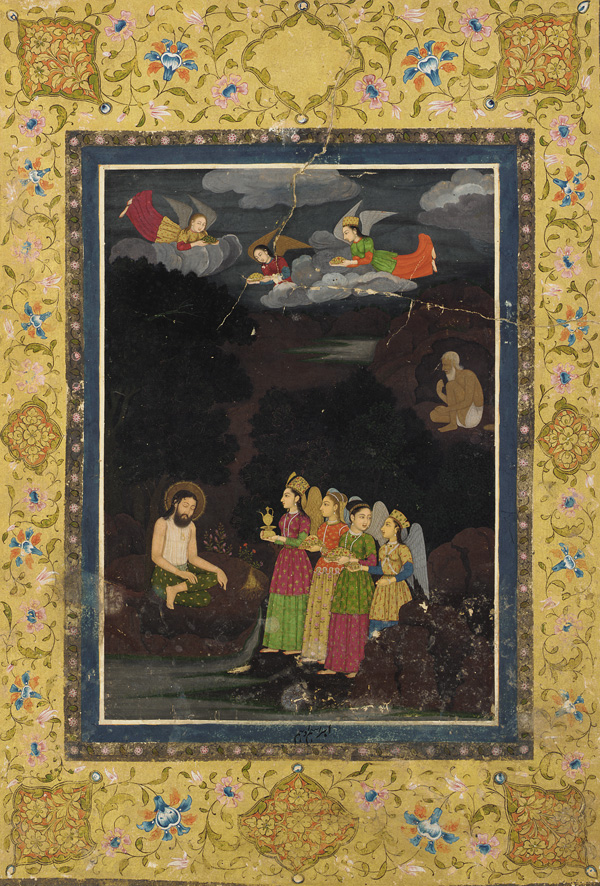
late 17th century
Mughal
Color and gold on paper
H: 23.8 W: 16.9 cm
India
Gift of Charles Lang Freer, F1907.198
Since the first moment he decided to follow the Sufi path, his only sustenance came from his work. He dedicated his working time to gather seeds, working the field and gardening. One day, while he was on the desert, he came to meet a man who told him the "Uppermost name of God" (al-Ism al-Á‘zam), and he invoked this Name. And then, he saw Al-Jidr, who told him that it was prophet David ((Dâwûd) who had transmitted it. Ibrâhîm ibn Ádham was very severe in regards to the practice of Wára‘, consisting in the scrupules that divert muslims from the Harâm, refraining from all the things that the Sharî‘a considers illicit, and even many licit actions (Mubâh), Ibrâhîm refrained from doing them from fear that it would make him forget his dedication to Allah. He used to say: "Be your feed the fruit of your honest work, and do not worry if your prayers in the night are not many or if you do not fast with the intensity that you would like..."
One of his invocations was "Allahuma, transport me from the humiliation that represents the fact of disobeying you to the pride for submiting to you." Ibrâhîm ibn Ádham said one day to a man who was doing the circular steps (Tawâf) around the Ka'aba: "You will not attain the degree of the Sâlihîn until you have stepped on six slopes: the first one means that you must close the door to happiness and open the one to calamities; the second meand that you must close the door to the pride and open the door to humility; the third means that you must close the door to rest and open the one to severity; the fourth means that you must close the door to sleep and open the one to insomnia; the fifth is that you must close the door to weatlh and open the one to poorness; the sixth means that you must close the door to hope and open the one that prepares you to embrace death.
One day he was taking care of a vineyard and a soldier passed by Ibrâhîm ibn Ádham and asked him to give him a bunch of grapes. " The owner of this vineyard put me to care for it", Ibrâhîm replied, and the soldier took out his whip and started floggin him. Ibrâhîm took all that pain saying: "Yes, yes!, whip this slave's face who never stops serving his Lord." Finally the soldier stopped when he got tired and let Ibrâhîm in peace.
Sahl said that once he travelled with Ibrâhîm ibn Ádham. Sahl felt ill and Ibrâhîm spent all his money to care after him. While Sahl was deluring, he asked for something and Ibrâhîm sold his donkey in order to get the money and buy what Sahl asked for. When Sahl recovered, he asked Ibrâhîm where the donkey was, as they were getting ready to pursue their trip. "I sold it", Ibrâhîm replied. "Then, how are we going to travel now?", Sahl asked. And then Ibrâhîm put Sahl on his shoulders and walked for three journeys this way.
The First Sufis. From 2nd chapter Risâla al-Qusháiri. Part One.
Sunday, October 03, 2004 By Maryam
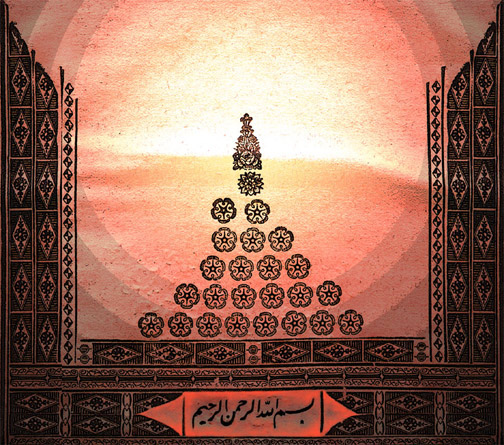
"You must know that among the first muslims there was nothing that could distinguish them more but the fact of having been with the Prophet (pbuh), and those who took a special mention among them were called Sahâba (companions) as they had personally met Rassulullah and had enjoyed from his company (suhba). And then, the second generation of muslims used as title of privilege for those who were best among them Tâbi‘în, Pursuers, who had recieved directly the teachings from the Sahaaba. As for the third generation, the chosen name was Tâbi‘î t-Tâbi‘în, Pursuers of the Pursuers, or Followers of the Followers, meaning those who had the teaching of the Tâbi‘în regarding Islam. And, the group of these three generations receives the name Sálaf, our ancestors in Islam.
After these three generations, Sálaf, and once Islam had expanded through the lands, sincerity and compromise of the Dîn were still very present in some, and those people were called Çuhhâd, Ascetics.
But Islam continued its expansion and started to suffer its first divisions and some parties became to follow paths that were getting far from the source of Islam, who liked to show off how many Çuhhâd were among their groups. Therefore, the people of the Sunna, started changing that word to another more according to those who followed the original teachings of Sidnâ Muhammad (pbuh) and this name , this word to designate these kind of people became Tasáwwuf, with the derived name Sûfi. Since then, it is this word the one that has continued to designate those who keep the Oneness and deffend their hearts from any kind of carelessness.
To be continued part One
IBN al-'ARABI
Friday, October 01, 2004 By Maryam

any form:
for gazelles a meadow,
a cloister for monks,
For the idols, sacred ground,
Ka'ba for the circling pilgrim,
the tables of the Torah,
the scrolls of the Qur'an.
I profess the religion of love.
Wherever its caravan turns
along the way, that is the belief,
the faith I keep.
13th-century Sufi