Thursday, June 30, 2005 By Maryam

Truth,
the immensity of oneness
the level of anything
the incommensurable path
that I perceived
through old and vast corridors.
The perfume of freedom
The labor of life
and love
and death/
It was suddenly
that the name became more audible in my heart;
it became the words of a song that i always sing
especially when I dream.
Then it becomes like a fountain, a waterfall, a heavy rain
that sweeps my tears.
And it was like a figure, bowing, pleasing
that whispered Your Name again
or anew
But in any case,
I love to remember
the patient times
and the suffering.
They brought me an endless heaven to see
on the nights and days of songs filled with that name.
And now time only shows rivers drawing lines, hearts becoming more loving
enduring the human's creations
and the years that one day will never be.
Maryam


Symposium in Damascus about the figure of Ibn' Arabi
Tuesday, June 28, 2005 By Maryam
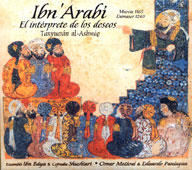
The international symposium on sufism ends next Friday in Damascus and has noted that its significance come from the universality of Ibn Arabi who connected between cultures to later have great affect on western thought.
Director of the French Institute forear East Studies and head of the Spanish cultural center of Cervantes in Damascus stressed in their interposing that "the symposium importance comes from the internationality of Ibn Arabi as a Sufi, poet and philosopher, as well as a wise man who is considered one of the great teachers of spirituality for humanity." "Ibn Arabi was capable of joining the Spanish and Arabic cultures as well as to leave the most effective impact in the development of the western thought later on," they said.
Minister of Culture, Mahmoud al-Sayyed pointed out that humanity was in dear need to the high values of Ibn Arabi embodied in fraternity, amity and cordiality.
"The effect of Ibn Arabi is not restricted to the Arab culture, but rather to the Iranian and Indian cultures in addition to Asia, North Africa and Europe," he said.
The gathering will count with the participation of Arab and foreign intellectuals.
Ibn Arabi has born in Andlous of Spain in 1165 and lived a life full of production during which he wrote more than 400 letters and books on the unification of the existence and divine love. He died in Damascus and was over 75.
Source: Arab News
sufism
Davudnejad to make film on Rumi
Tuesday, June 28, 2005 By Maryam

Director Alireza Davudnejad is planning to make a historical film on the life of Mowlana Jalal al-Din Rumi.
He said on Tuesday that the film will depict the series of events leading to Rumi’s spiritual transformation after his meeting with Shams Tabrizi.
“At the present moment, I am working with several researchers on the main theme of the film, and the screenplay will be
(read more)
sufism
Carta de un musulmán a un hombre honesto
Tuesday, June 28, 2005 By Maryam

El presente poema me ha sido enviado por el hermano llamado Ahmad Munir, visitante de este blog. El texto me llegó muy al alma y aquí lo vuelvo a transcribir con su permiso para la reflexión de otras almas.
Por que me miras tan en silencio...?
Crees que debajo de mi piel
hay otro que no soy yo y respira mal?
Que puedo ser tal vez el árbol marchito,
El geranio roto por dentro...?
O tal vez el oscuro pantano de tu silencio?
No soy yo ni tu, el camino de los espinos,
No soy el blanco del odio ni la muralla
entre tu y el río de tu destino
No llevo en la alforja de mi viaje armas
Llevó un tapete de oración, un poco de incienso
Y tampoco voy a decirte al oído mentiras
Porque no te hablo al oído, sino canto y
Si no quieres escuchar no te alejes, yo me alejo.
Quieres saber si sufro acaso por tus ojos
Que evaden mi rostro y lo ocultan?
Sufro, es cierto, por no poder compartir
El canto de tu corazón y lloro porque soy débil
Y ante Dios me quejo de mi debilidad y
de buscar en tus manos protección.
Pero en la Luz de Su rostro me he refugiado.
Mira como el lento desfile de las olas del verano
acaban en la playa de mi cara y de la tuya,
mira las manos de mis hijos y los tuyos
anhelantes queriendo tocar el secreto del sol
y de la luna fulgurante, y de las estrellas que pasan
Mirame, solo mirame y deja que te mire
solo por un instante con todo el ser por entero,
y no me digas nada. Perdoname si me ves altivo,
no es lo que me han enseñado.
Dejame solo pedir paz para tu alma,
Y no me censures por regresar al lugar
de donde nunca he salido, y donde supe de ti.
Con el Dios de mi vida, El Uno, el Eterno.
Ahmad Munir al-Jerrahi
categoría:
sufismo
poema sufi
Science & Theology News: Duality and non-duality in Science and religion
Tuesday, June 07, 2005 By Maryam
By Mark MacDowell and Paul Utukuru
(May 26, 2005)
A bad workman blames his tools, but what if the tools are just not sharp enough for the job?
A major problem in modern cosmology is related to the issue of duality and non-duality, which is directly related to the only tool available to us: mathematics. With math, we try to trace back the origins of our universe to the point when space and time did not exist. All goes well until we get to just a moment after the big bang. Beyond that, our mathematics breaks down and refuses to go back any further to the exact moment of the event, usually referred to as the space-time singularity.
This breakdown occurs for two reasons. One is that our cosmological mathematics is either time-dependent, meaning that there is no change in space without some reference to a change in time, or space-dependent, meaning that there is no time without some reference to a change in space. That being the case, how can we ever describe mathematically the space-time singularity that doesn’t exist in space-time?
Continue Reading this article...
Sufism and Breath
Tuesday, June 07, 2005 By Maryam
by
Shaykh Muhammad Hisham Kabban II
From the Life of the Sufi Master Jafar as --Sadiq:
"I saw someone sitting beside me invoking God saying 'Ya Allah, Ya Allah...' repeatedly until he lost his breath. He then continued by saying 'Ya Hayy, Ya Hayy...' I asked..., 'who is that?'
He replied, 'that is the great Imam, Ja'far as-Sadiq.' I ran after him to find him but he had disappeared."
Unveiling the Heart's Eye
Most Sufi paths offer aspirants a gradual unveiling of the heart's eye, accomplished trough the practice of Dhikr. The commemoration of Allah. This spiritual exercise may contain repetition of various of Allah's Holy Names. Some of them involve practices design to break the spell of mundane consciousness and propel the practicioner into a state of altered awareness. Such practices may includes repetition of many thousands of holy phrases sometimes connected with breathing exercises and often with physical movements. Without a doubt through the steadfast and dedicated practice of these methods the aspirant may experience spiritual states and attain stations unimaginable in a normal state of consciousness: may feel himself to be flying towards the heavenly goals, beholding the wonders of the mysterious and hidden aspects of creation.
Conscious Breathing ( "Hosh dar dam" dam"))
Hosh means "mind." Dar means "in." Dam means "breath." It means, according to Master
Abdul Khaliq al-Ghudjdawani "for the wise seeker to safeguard his breath from heedlessness which makes the heart always in the Divine Presence. And to revive his breath with worship and servitude and to dispatch this worship to His Lord full of life. Because every breath which is inhaled and exhaled with Presence is alive and connected with the Divine Presence, and every breath inhaled and exhaled with heedlessness is dead, disconnected from the Divine Presence."
Sayiddina Ubaydullah al-Ahrar said,
"the most important mission for the seeker in this Order is to safeguard his breath, and who cannot safeguard his breath it would be said of him 'he lost himself.'"
Shah Naqshband said, "This Order is built on breath. So it is a must on everyone to safeguard his breath in the time of your inhalation and exhalation and further, to safeguard the breath in the interval between the inhalation and exhalation."
Shaikh Abul Janaab Najmuddin al-Kubra said in his book Fawatih ul-Jamaal said,
"Dhikr is flowing in the body of creatures by the necessity of their breath, because through their breathing, the letter 'Ha' of the Divine Name 'Allah,' is the very sound made with every exhalation and inhalation and it is a sign of the Unseen Essence serving to emphasize the Uniqueness of God. Therefore it is necessary to be present with that breathing, in order to realize the Essence of the Creator.
God's name 'Allah' encompasses God's ninety-nine Names and Attributes and consists of
four letters, 'Alif,' 'Lam,' 'Lam' and 'Hah' (ALLAH). The people of Sufism express that the absolute unseen Essence of God, Glorious and Exalted, is expressed by the letter 'Hah' which represents the Absolute Unseen which is the same letter 'Hah' which is used in the name 'Allah' which encompasses the ninety-nine Names and Attributes. That name, as we said, consists of four letters: the letter 'Ha' which is 'Ha' and 'Alif', and it represents the Absolute Unseen of Allah. The first 'Lam' is for the sake of identification and the second 'Lam' is for the sake of emphasis.
Safeguarding your breath from heedlessness will lead you to the Complete Presence and the complete presence will lead you to the complete vision and the complete vision will lead you to the copmlete manifestation of God's 99 Names and Attributes. This leads you to manifest God's Ninety-Nine Names and Attributes and all His other Attributes, in affirmation of the Saying:
"Allah's Attributes are as numerous as the breaths of human beings."
It must be known by everyone that securing the breath from heedlessness is difficult for seekers. Therefore they must safeguard it by seeking forgiveness.
From All About Islam
sufism